

Glass bottle neck finish precision and the technical Cork vs. Screw Cap debate have officially transitioned from secondary packaging considerations to core strategic priorities for the 2026 beverage industry. As the global caps and closures market expands toward a projected USD 140.40 billion by 2034, spirits and wine producers must navigate rigorous new GME standardization mandates and the Sustainable Wine Roundtable (SWR) lightweighting targets . This report analyzes the engineering shift from traditional sealing to precision-molded systems, providing a strategic roadmap for stakeholders to maintain quality and regulatory compliance.
The Global Market Transition: Navigating the Cork vs. Screw Cap Divide
The Cork vs. Screw Cap selection process is currently being reshaped by a global market valued at USD 81.86 billion as of 2025, growing at a CAGR of 6.21% . In the high-stakes Cork vs. Screw Cap rivalry, aluminum screw caps have achieved a dominant 37% share of the global wine market, particularly as exporters pivot toward regions like Asia-Pacific, which held a 35.99% revenue share in 2025 . In mainland China, a notable 77% surge in white wine imports—a category where the Cork vs. Screw Cap choice heavily favors aluminum for freshness—is re-engineering regional demand patterns. Despite this trend, natural cork remains the benchmark for premium quality; a 2025 survey indicates that 97% of US consumers still associate natural cork with high-end wine. However, the Cork vs. Screw Cap decision is increasingly influenced by the European Union’s Packaging and Packaging Waste Regulation (PPWR), which mandates a transition to circular materials by August 12, 2026 .
Technical Interpretation: Engineering the Perfect Glass Bottle Neck Finish
Precision in the glass bottle neck finish is non-negotiable for maintaining seal integrity and preventing product loss in premium spirits and wines. For industry professionals, the glass bottle neck finish serves as the critical interface between the container and the closure, requiring micron-level accuracy across the “T” (thread diameter), “E” (neck diameter), and “I” (inner diameter) dimensions . The 2025-2026 CETIE GME series updates—specifically GME51.00 for spirits and GME14.12 for reduced-bore finishes—have introduced tighter tolerances to eliminate product leakage and premature oxidation .For industry professionals, the glass bottle neck finish serves as the critical interface between the container and the closure. A secure seal requires micron-level accuracy across the “T” (thread diameter), “E” (neck diameter), and “I” (inner diameter) dimensions. The 2025-2026 CETIE GME series updates—specifically GME51.00 for spirits and GME30.14 for pilfer-proof finishes—have introduced tighter tolerances to eliminate product leakage and premature oxidation.
| Closure Type | OTR Range | Primary Sealing Mechanism | Best Use Case |
| Natural Cork (Flor/First) | 1.7-6.1 | Cellular expansion/diffusion | Long-term aging reds |
| Technical/Agglomerated Cork | 0.1-0.4 | Engineered compression | Consistent aging spirits |
| Aluminum Screw Cap | 0.2-0.7 | Liner compression/permeation | Fresh whites, rosés |
| Synthetic (Polyethylene) | 6.0-15.0 | Polymer permeation | Young wines (<3 years) |
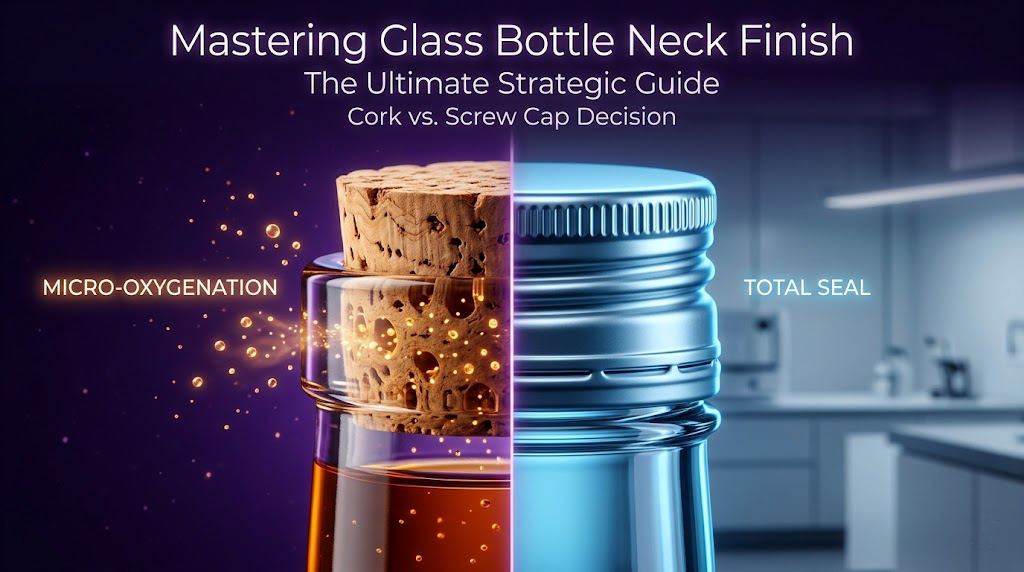
Technical differentiation within the glass bottle neck finish is most evident in Oxygen Transmission Rates (OTR). Screw caps offer a near-zero, consistent OTR of $0.2-0.7$ µL/day, whereas natural cork allows a controlled, variable exchange of $1.7-6.1$ µL/day, which is essential for the maturation of red wines . Furthermore, the SWR’s Bottle Weight Accord is forcing a transition to “Lightweight Luxury,” targeting an average bottle weight below 420g by the end of 2026 . This requires a glass bottle neck finish that can maintain structural integrity under high-speed capping torque while using significantly less material to meet global decarbonization goals .
Strategic Recommendations: Valiant Packaging’s Approach to the Glass Bottle Neck Finish and the Cork vs. Screw Cap Transition
For Valiant Packaging, optimizing the glass bottle neck finish is a pillar of our vertical integration strategy, ensuring that our in-house mold workshop can respond to the shifting Cork vs. Screw Cap preferences of global brand owners . We anticipate that demand for high-precision, screw-cap-compatible finishes in the Asia-Pacific market will increase by 12% by 2028, and we recommend that spirits brands prioritize custom mold development to ensure leak-proof performance in e-commerce channels .
Strategic Roadmap for 2026:
- Precision Engineering: We are scaling the production of IS machines and molds that strictly adhere to GME30.14 and GME51.00 standards to ensure a perfect glass bottle neck finish .
- Material Optimization: Valiant is prioritizing 420g-compliant glassware to help partners navigate the Cork vs. Screw Cap technical challenges associated with lightweighting .
- Circular Compliance: To meet the August 12, 2026 PPWR deadline, we are expanding our portfolio of food-grade PCR resins and sustainable alternatives for every glass bottle neck finish we produce .
- Smart Integration: We encourage the adoption of NFC and QR-coded closures within the glass bottle neck finish to enhance consumer engagement and supply chain transparency .
Conclusion: The Future of the Glass Bottle Neck Finish
The evolution of the glass bottle neck finish from a simple container feature to a high-performance engineering system is a strategic necessity for the circular economy. While the Cork vs. Screw Cap debate will always be influenced by tradition, the future of the industry will be defined by “system-level optimization”—where the glass bottle neck finish and the closure function as a single, sustainable entity. Shandong Valiant Packaging is uniquely positioned to bridge this technical gap, providing the global alcoholic beverage industry with the precision and innovative materials required to thrive in a precision-driven market .