Abstract
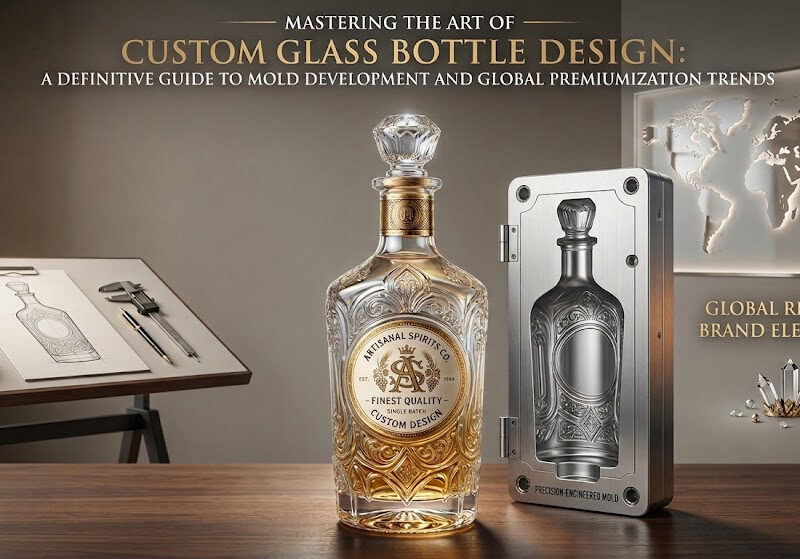
Custom glass bottle design is the primary architect of brand identity in the modern global spirits and wine markets. As the industry moves toward “super-premiumization,” the glass container has evolved from a functional vessel into a sophisticated tool for sensory storytelling and value signaling . For brands in Europe, the Americas, Australia, and Southeast Asia, the transition from standardized stock glass to a bespoke custom glass bottle design is a strategic necessity to navigate saturated retail environments and meet rising consumer expectations for authenticity . This report provides an in-depth analysis of the technical lifecycle of bespoke glass, from the engineering rigors of mold development to the logistical impact of “lightweight luxury” and the strategic manufacturing advantages offered by vertically integrated partners like Shandong Valiant Packaging.
The Technical Evolution of Custom Glass Bottle Design in Global Markets
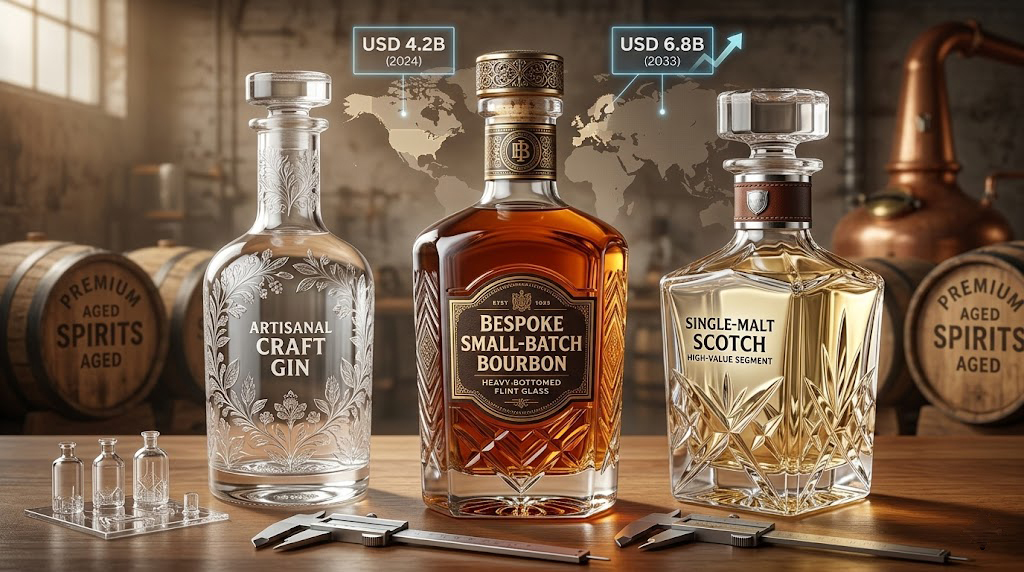
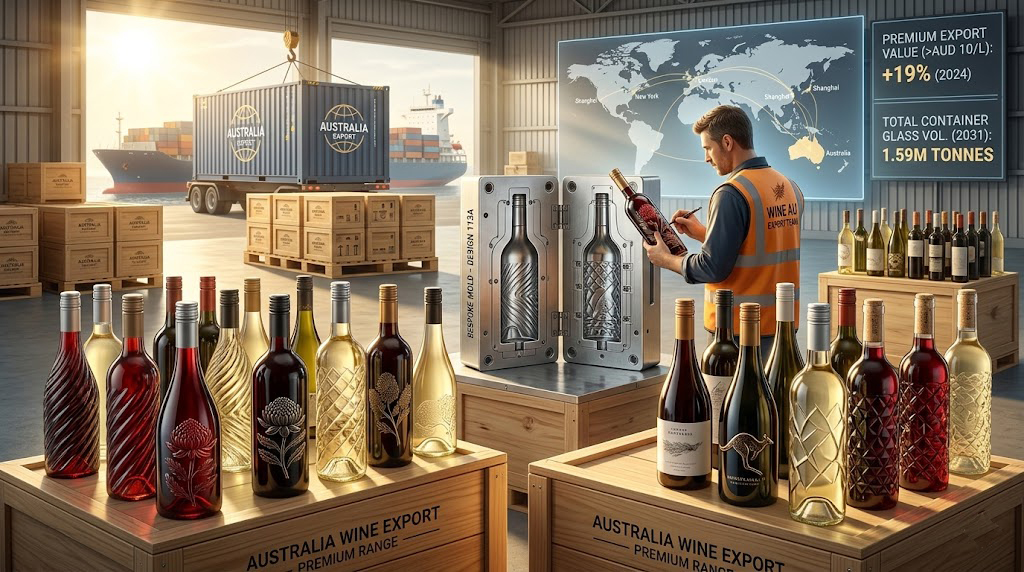
The shift toward custom glass bottle design is supported by a significant shift in global market valuations. In North America and Europe, the premium spirits glass packaging sector was valued at USD 4.2 billion in 2024 and is projected to reach USD 6.8 billion by 2033, growing at a CAGR of 5.5%. This growth is particularly pronounced in “high-value” segments—such as craft gin, small-batch bourbon, and single-malt scotch—where the bottle serves as a critical communicator of craftsmanship. In Australia, while the overall container glass market is mature with a projected volume of 1.59 million tonnes by 2031, there is a distinct surge in demand for bespoke shapes for premium wine exports, which grew 19% in value for products priced above AUD 10 per liter in 2024.
| Region | Market Valuation (Base Year) | Forecast Valuation (2030-2035) | Projected CAGR | Key Driver |
| Europe | USD 21.0 Billion (2023) | USD 30.75 Billion (2030) | 5.6% | Circular Economy Regulations |
| North America | USD 4.2 Billion (2024) | USD 6.8 Billion (2033) | 5.5% | Spirit Premiumization |
| Asia-Pacific | USD 28.33 Billion (2025) | USD 34.61 Billion (2031) | 3.39% | Rising Disposable Income |
| Australia | 1.47 Million Tonnes (2025) | 1.59 Million Tonnes (2031) | 1.30% | Premium Wine Exports |
| Global Spirits | USD 7.7 Billion (2025) | USD 12.1 Billion (2035) | 4.6% | Luxury Branding & Gifting |
In the Asia-Pacific region, which holds a 41.33% global market share in glass packaging, consumption is shifting away from volume-driven expansion toward value-enhancing applications. China alone captured 37.89% of the regional market share in 2025, driven by the premiumization of traditional spirits like Baijiu and the rising demand for Western-style craft spirits. This landscape necessitates a custom glass bottle design that can withstand global shipping rigors while maintaining a premium shelf presence—especially as Gen Z consumers in North America (38% of whom abstain from alcohol) increasingly opt for “better” rather than “more,” driving 10.6% volume growth in non-alcoholic spirits that utilize ultra-premium glass to signal quality parity.
Professional Interpretation: The Architecture of Mold Development and Engineering
A successful custom glass bottle design must reconcile artistic vision with the uncompromising physics of molten glass manufacturing. The lifecycle of a bespoke bottle typically spans eight weeks from concept to physical sample, anchored by the precision of mold development .
Precision Engineering and Mold Materials:
The backbone of custom glass bottle design is the high-precision mold. Molds are typically fabricated from high-grade H13 tool steel or specialized cast iron to withstand abrasive molten glass at temperatures exceeding 1000℃. Engineering for complex shapes, such as square-shouldered spirits bottles or those with deep 3D embossing, requires advanced cooling systems within the Individual Section (IS) machine to prevent thermal stress and “thin spots” . 3D CAD modeling allows engineers to simulate the “parison” (the preliminary glass shape) to ensure uniform glass distribution, which is critical for structural integrity during the rapid cooling phase .
| Component | Engineering Requirement | Impact on Design |
| Mold Material | H13 Tool Steel / Cast Iron | Ensures dimensional accuracy for up to 1 million cycles |
| Wall Thickness | 2.5 mm – 4.0 mm | Balances durability with thermal shock resistance |
| Tolerance | ± 0.1 mm to ±0.2 mm | Critical for leak-proof seals on filling/capping lines |
| Neck Finish | BPF, MCA, or Cork | Determines closure fit and flavor preservation |
| Base Design | Heavy base / Punt | Enhances “Premium Feel” but adds material cost |
Prototyping: The Rapid Tooling Revolution
Historically, the most significant barrier to custom glass bottle design has been the “speed-to-market.” Traditional metal pilot molds add six to twelve weeks to the development cycle . However, the integration of Stereolithography (SLA) 3D printing has revolutionized this phase. Using 3D-printed mold inserts, functional “pre-production” bottles can be produced in just two weeks—a 70-90% reduction in lead time and cost . These prototypes are “fully dense and isotropic,” mimicking the transparency and feel of final glass, which allows brands to validate ergonomics, star-wheel compatibility on filling lines, and consumer appeal before committing to expensive production tooling .
The “Lightweight Luxury” Paradox
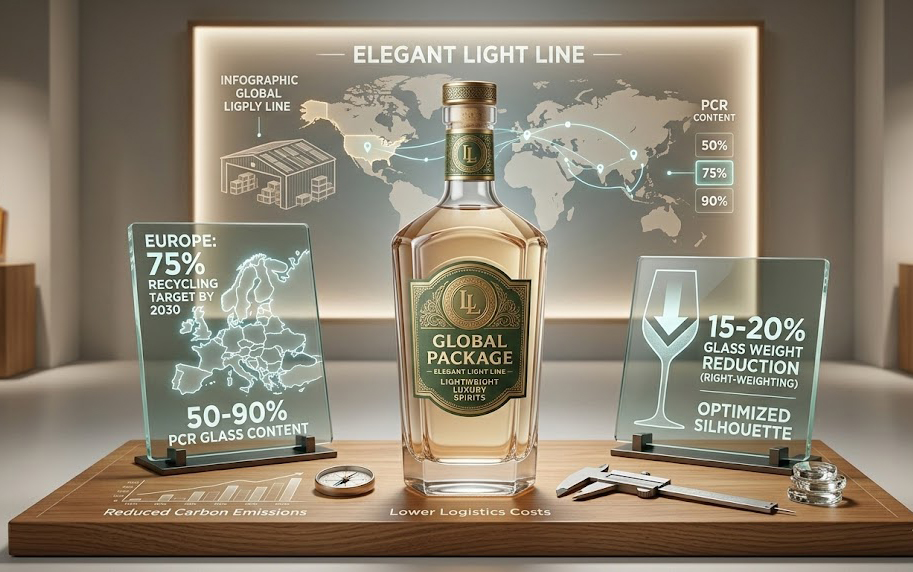
Sustainability is now an inextricable component of custom glass bottle design. In Europe, a 75% recycling target by 2030 is driving demand for bottles with 50-90% Post-Consumer Recycled (PCR) glass content (cullet). The industry is pivoting toward “right-weighting”—reducing glass weight by 15-20% through optimized silhouettes without sacrificing the “premium” tactile experience. For example, Global Package’s “Elegant Light Line” demonstrates that sophisticated silhouettes can reduce carbon emissions and logistics costs while maintaining shelf presence.
Strategic Implications for Valiant Packaging and Industry Recommendations
Shandong Valiant Packaging (Valiant Group) is uniquely positioned as a vertically integrated leader, offering “one-stop-shop” services that include in-house mold departments, glass manufacturing, and advanced deep processing.
Strategic Recommendations for Packaging Innovation
- Agile Mold Development: To support the fast-growing craft spirits sectors in Southeast Asia and Australia, Valiant should further institutionalize rapid prototyping using 3D-printed mold inserts. Reducing the development window from eight weeks to under three weeks provides a decisive advantage for brands responding to seasonal trends .
- Multi-Sensory Deep Processing: The 2025-2026 spirits trends emphasize tactile engagement. Valiant should leverage its expertise in screen printing, acid etching, and hot foil stamping to create custom glass bottle design solutions that communicate luxury without the need for large paper labels. Techniques like “imperfect” glass finishes that mimic heritage craftsmanship create a physical connection that digital marketing cannot replicate .
- ESG-Centric Manufacturing: Aligning with European and Australian circular economy mandates, Valiant should continue maximizing its cullet intake—currently supported by 100% PCR glass capability. Transitioning more production to furnaces with electric boosting and utilizing its 5 MW of onsite solar/wind power allows Valiant to offer “carbon-neutral” packaging essential for the sustainability reports of multinational conglomerates.
- Smart and Connected Packaging: The integration of QR codes and NFC chips into custom glass bottle design is a USD 2.1 billion opportunity for brand protection and consumer engagement. Valiant’s mold department should develop standardized recesses for these technologies, ensuring they do not interfere with the bottle’s aesthetic lines or labeling.
Conclusion and Outlook
The transition to a first custom glass bottle design represents the intersection of industrial engineering and brand strategy. As global markets in Europe, the Americas, and Asia continue to premiumize, the bottle will increasingly be viewed as the “physical representation of a brand’s essence” . The future lies in balancing technical complexity with “Lightweight Luxury” and circular economy principles. For professionals in the supply chain, custom glass bottle design is no longer a commodity purchase but a strategic pillar that dictates long-term brand identity, environmental compliance, and financial resilience.