Abstract
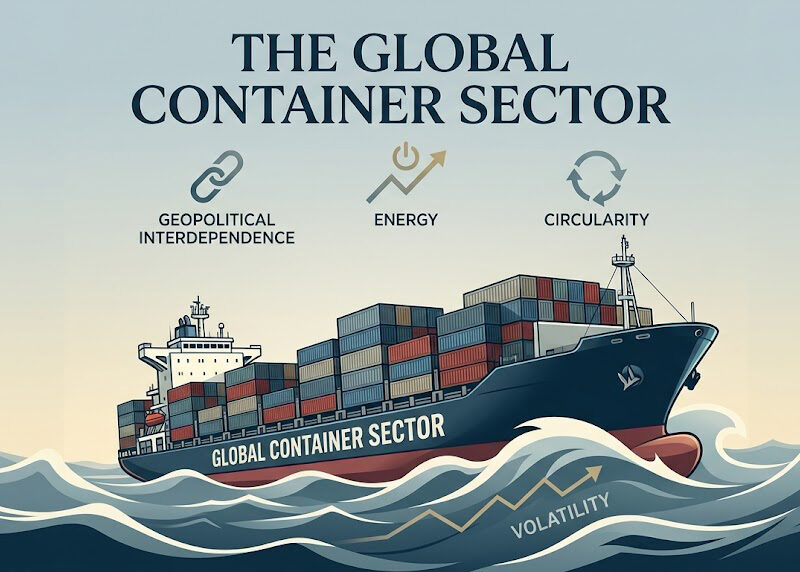
The global container sector, long considered a bastion of stability within the FMCG supply chain, is currently navigating a period of unprecedented volatility. This “perfect storm” is characterized by geopolitical conflict, energy price spikes, and an aggressive regulatory pivot toward circularity.
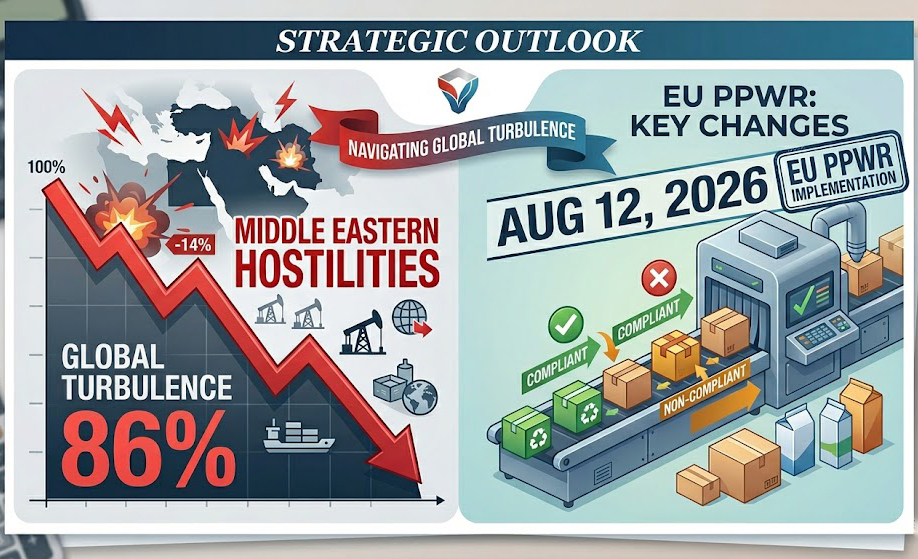
This report, authored from the perspective of Shandong Valiant Packaging, examines seismic shifts occurring in early 2026. Most notably, we analyze the 14% contraction in global indices triggered by Middle Eastern hostilities and the looming August 12 implementation of the EU Packaging and Packaging Waste Regulation (PPWR).
The following analysis demonstrates that traditional procurement metrics—primarily unit cost and volume—are being replaced by a sophisticated hierarchy of value. This new value is defined by carbon accounting, material weight efficiency, and supply chain regionalization. For beverage producers and intermediaries, understanding these shocks is required for maintaining brand equity where “premium” is synonymous with “sustainable”.
Macro-Economic Shockwaves—Energy and Industrial Instability
The industrial landscape in March 2026 is defined by a sharp divergence between historic forecasts and immediate geopolitical realities. While the vitreous container market is projected to reach USD 78.55 billion by 2035 with a steady CAGR of 6.10%, the immediate term has been marred by a 14% sell-off in industrial stocks since February 28, 2026.
This financial contraction stems from an “energy shockwave” pushing Brent crude toward $120 per barrel. European natural gas indices (TTF) have spiked by over 60% in days. In energy-intensive manufacturing, fuel accounts for up to 35% of total production costs, making these spikes punitive for margins.
Labor markets have added further complexity. Workers at Encirc, a pivotal manufacturer for brands like Jameson, scheduled strikes for late March 2026 over proposed headcount reductions. Despite parent company Vidrala reporting high 2025 profits, rising fuel costs and the new Extended Producer Responsibility (EPR) taxes have forced a rationalization of labor.
Simultaneously, the South American viticultural sector faces a structural collapse. Iconic producers in Argentina, such as Bodega Norton, have entered administration with debts reaching 64 billion pesos ($43 million). This crisis is exacerbated by a 28% decline in domestic consumption and a pivot toward low-value bulk exports, decimating the demand for premium silica containers in the region.
| Global Market Metrics (March 2026) | Data/Statistic |
| Packaging Stock Index Performance | 14% Decline (Post-Feb 28) |
| European Natural Gas (TTF) Increase | 60% Spike |
| Glass Production Energy Cost Share | Up to 35% of Total |
| Glass Bottle Market Value (2026) | USD 47.46 Billion |
| Projected Glass Market Value (2035) | USD 82.7 Billion |
| Encirc Elton Site Production Volume | 3 Billion+ Containers Annually |
| Argentina Wine Export Revenue (Feb 2026) | 7.6% Decline in Value |
Professional Interpretation—Technical Transitions and Regulatory Paradigms
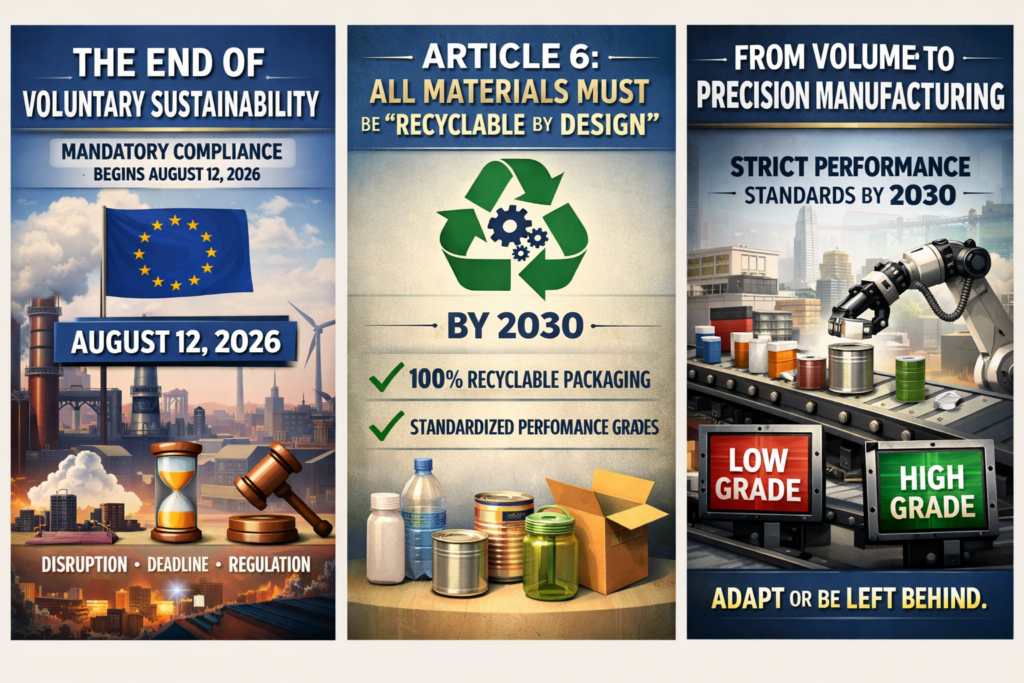
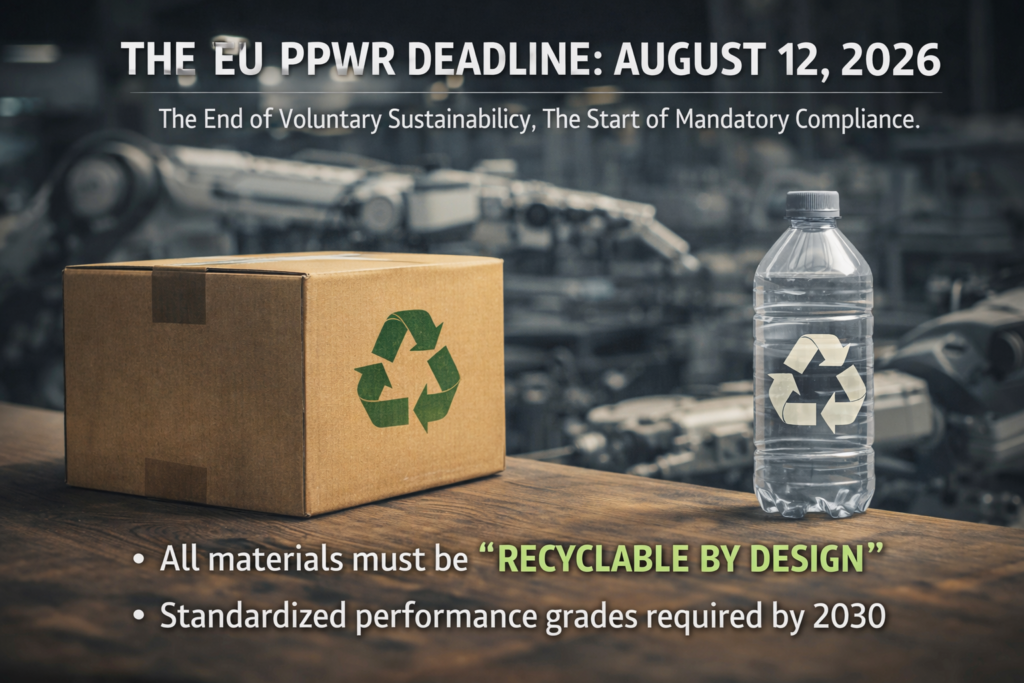
The “shocks” identified are not merely temporary disruptions; they are accelerating a fundamental technical transition. The August 12, 2026, deadline for the EU PPWR marks the end of voluntary sustainability and the beginning of mandatory compliance.
Under Article 6, all materials must be “recyclable” by design. By 2030, all vessels must meet standardized performance grades to maintain market access. This regulatory environment forces a shift from volume-driven competition to precision manufacturing.
Lightweighting and NNPB Technology
The most tangible response to rising energy costs is the aggressive adoption of lightweighting. Industry leaders are targeting a reduction of 750ml still wine bottles to below 420g by late 2026. This standard is facilitated by Narrow-Neck Press and Blow (NNPB) technology.
This process allows for a 20% reduction in unit weight while maintaining structural durability for high-speed filling lines. Weight reduction is now a logistics necessity to offset “freight penalties” as global fuel costs soar.
Decarbonization and Furnace Electrification
The energy crisis is also serving as a catalyst for the “Year of Execution” in decarbonization. 2026 marks the tipping point where hybrid and electric melting technologies are moving from pilot phases to commercial scale. Hybrid furnaces, such as those deployed by Ardagh in Germany, utilize up to 60-80% electric heating, achieving carbon emission reductions of 64% per bottle. Furthermore, the industry is increasingly auditing “facility-specific carbon data” to comply with the EU’s Carbon Border Adjustment Mechanism (CBAM), which now penalizes default emission values for imported glass.
Labeling and Circular Economy Mandates
The energy crisis is a catalyst for the “Year of Execution” in decarbonization. 2026 marks the tipping point where hybrid and electric melting technologies move to commercial scale.
Hybrid furnaces, such as those used by Ardagh, utilize up to 60-80% electric heating. These achieve carbon emission reductions of 64% per unit. Furthermore, the industry is increasingly auditing “facility-specific carbon data” to comply with the EU’s Carbon Border Adjustment Mechanism (CBAM).
Labeling and Circular Economy Mandates
Labeling technology is similarly evolving to support circularity. Breakthroughs like BASF’s RecyClass-approved adhesives ensure high-clarity labels can be fully washed off during recycling.
This is critical as the industry seeks to increase the “cullet integration ratio.” Every 10% increase in recycled material reduces furnace energy consumption by 3% and carbon emissions by 7%.
Strategic Recommendations for Valiant Packaging
As a leading provider of global solutions, Shandong Valiant Packaging is uniquely positioned to capitalize on these market fluctuations. We leverage vertically integrated manufacturing and a “China Strategic Buffer” to provide stability.
Implementation of “Lightweight Luxury” Design
Valiant should expand its “Elegant Light Line,” using NNPB technology to meet the 420g benchmark. This must be done without sacrificing the premium aesthetic and tactile “Quiet Luxury” demanded by the spirits sector.
Ready-for-Compliance Decoration
To address the EU PPWR labeling requirements taking effect in August 2026, Valiant must standardize the integration of QR codes and material-composition pictograms into its decoration services (screen printing, acid etching, and hot foil stamping). By offering “compliance-as-a-service,” Valiant can become the preferred partner for spirits and wine exporters in the APAC and South American regions who need to guarantee their packaging meets European digital labeling and traceability standards.
Strategic Diversification
While traditional wine markets are volatile, the “Clean Beauty” and “Craft Beverage” sectors in Southeast Asia are expanding. Valiant should pivot design focus toward customized, high-clarity flint jars where brand differentiation justifies elevated retail pricing.
Conclusion and Outlook: The Tipping Point of 2026
The global market is at a historical crossroads. The disruptions of March 2026 have exposed the fragility of the traditional high-volume, low-cost model.
However, these challenges drive innovation. The survivors will be those providing “stability as a service” while meeting “Lightweight Luxury” and carbon-neutral mandates. For Valiant, the opportunity lies in combining heritage craftsmanship with precision 2026-era sustainability technologies.