
Table of Contents
Abstract

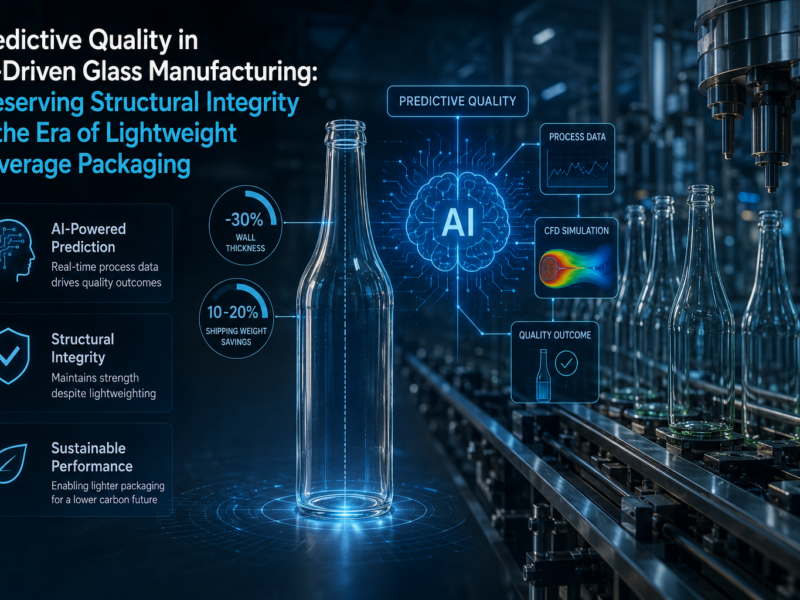
Predictive Quality has emerged as the defining paradigm in the global glass manufacturing sector, driven by the recent release of CelSian’s Celfos—an artificial intelligence-powered system designed to predict glass quality by linking real-time process parameters to qualitative container properties. Historically, furnace control systems prioritized stabilizing thermal environments, yet temperature stability alone failed to guarantee optimal structural outputs. Celfos resolves this limitation by integrating advanced neural networks with qualitative time-transient computational fluid dynamics (CFD) analysis via GTM-X, providing actionable operational insights that minimize production defects and sensor degradation inconsistencies. This technological breakthrough carries immediate, critical implications for the premium beverage packaging industry, where the dual demands of aggressive container lightweighting and rigorous structural durability are reshaping supply chain economics, cost structures, and corporate sustainability strategies.
Empirical Analysis of CelSian’s Celfos and Predictive Quality Core Data
Operational data from modern glass manufacturing indicates that energy consumption represents up to 14% of total production expenses, rendering process optimization a commercial necessity. CelSian’s Celfos system addresses these high overheads through Predictive Quality modeling, combining historical furnace records and real-time parameters with detailed GTM-X simulations. This system models batch blanket behaviors, redox chemistry, and the release of batch reaction gases into the combustion chamber to optimize temperature fields. Adopting these predictive thermal controls allows manufacturers to dynamically adjust temperatures, reducing furnace energy consumption by 15% to 20% while enhancing the optical uniformity and light transmission of the glass. At the inspection stage, deep-learning visual systems trained on millions of images identify microscopic structural anomalies—such as 0.1-millimeter bubbles, inclusions, and cracks—at a 99.7% quality assurance accuracy rate, far exceeding human capability. This accuracy is supported by rapid properties-prediction software such as PyGGi, which computes density, elastic moduli, and glass transition temperatures in just 1/100 of a second, replacing costly empirical trial-and-error cycles with real-time digital assurance.
Translating Predictive Quality into Glass Packaging Elements and Market Dynamics
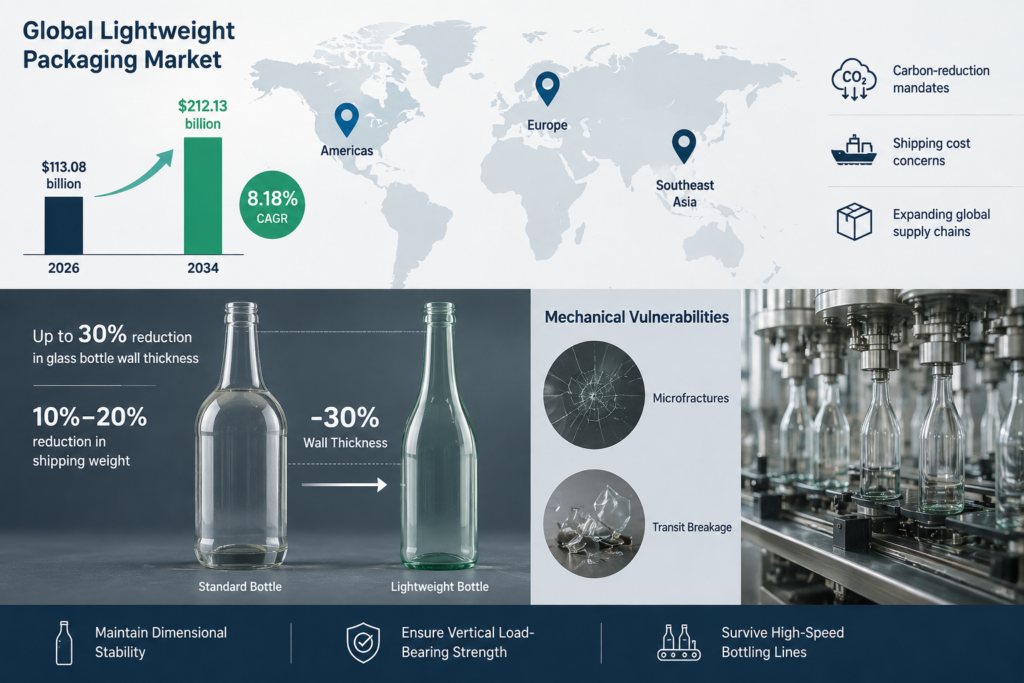
For spirits distilleries, wineries, and beverage supply chains across Europe, the Americas, and Southeast Asia, these advancements in Predictive Quality directly address the mechanical vulnerabilities associated with lightweight glass containers. Driven by carbon-reduction mandates and shipping cost concerns, the global lightweight packaging market is projected to expand from $113.08 billion in 2026 to $212.13 billion by 2034, representing a compound annual growth rate (CAGR) of 8.18%. However, reducing glass bottle wall thickness by up to 30% to achieve shipping weight savings of 10% to 20% dramatically increases the container’s susceptibility to microfractures and transit breakage. Unlike lightweight plastic containers, which are prone to paneling or collapsing inward under vacuum pressures , lightweight glass must maintain absolute dimensional stability and vertical load-bearing strength to survive high-speed automated bottling, capping, and sealing lines.
To achieve this, manufacturers utilize predictive simulations to optimize chemical modifier compositions—such as sodium oxide, calcium oxide, magnesium oxide, and aluminum oxide—which govern melt viscosity, forming stability, and final durability. Finite element stress analysis shows that physical design adjustments, such as implementing a 30-millimeter bottom punt on high-pressure sparkling wine bottles, alter stress distribution and reduce the first principal tensile stress in the base transition zone by 24.7%. This allows manufacturers to reduce wall and bottom thickness while safely retaining the standard 0.5 MPa internal pressure threshold. Backed by these structural innovations, econometric modeling predicts that the demand for sustainable, high-strength lightweight glass packaging in the North and South American spirits and wine markets will grow by 14.8% over the next five years, fueled by a 5% to 7% global CAGR for lightweight glass formats through 2030.
| Manufacturing Parameter | Legacy Glass Production Paradigm | AI-Enabled Predictive Quality Paradigm |
|---|---|---|
| Operational Control Metric | Static temperature stability inside the furnace superstructure | Time-transient CFD (GTM-X) and neural network quality correlation |
| Energy Consumption Efficiency | Unoptimized combustion; high fuel overheads (up to 14% of costs) | Real-time batch-blanket optimization; 15%–20% energy reduction |
| Structural Integrity Assurance | Post-cooling sorting; high rejection rates and manual inspection limits | Pre-emptive defect modeling; 99.7% accuracy for 0.1mm micro-cracks |
| Design and Mold Prototyping | Empirical trial-and-error physical mold tests taking weeks to months | CAD-integrated simulation tools reducing design cycles by 70% |
| Lightweighting Performance | High risk of wall thickness variation and transit microfractures | Optimized stress geometry; 30% wall reduction with high pressure tolerance |
Strategic Recommendations and Predictive Quality Innovations for Shandong Valiant Packaging
As an elite global OEM glass bottle manufacturer supplying spirits, wine, and beverage sectors in the Americas, Europe, Australia, and Southeast Asia, Shandong Valiant Packaging is uniquely positioned to capitalize on these Predictive Quality advancements. Operating state-of-the-art facilities equipped with fully automated IS machines and in-house CNC mold-making workshops, Valiant Packaging should deploy integrated CFD and stress simulation tools to reduce development and rapid prototyping times by up to 70%. To service the premium spirits segment—where brand identity demands heavy-base aesthetics alongside low carbon footprints—the analysis recommends that Valiant Packaging develop “hybrid-weight” container designs. These designs utilize advanced bottom-punt geometries and optimized wall-thickness distributions to reduce raw material consumption while preserving the premium tactile feel.
Additionally, integrating AI-driven visual inspection at the cold end ensures a zero-defect throughput, preventing costly product recalls and protecting brand reputation in high-speed bottling lines. The company should also leverage these precise glass forming techniques to expand its value-added services, ensuring that custom surface decorations like electroplating, screen printing, acid etching, and pressure-sensitive labeling are applied to structurally flawless, dimensionally perfect glass substrates. By adopting these smart production techniques, Valiant Packaging can offer highly customized, eco-efficient packaging that complies with ISO 9001, FSSC 22000, and ISO 14001 international standards, positioning itself as a premier technical partner for global beverage supply chains.
| Container Segment | Legacy Specifications (Average Mass) | Optimized Predictive Specification | Structural Mechanics & Material Innovation | Supply Chain & Financial Impact |
|---|---|---|---|---|
| Premium Spirits (750ml) | 750g Heavy-Base Flint Glass Bottle | 600g Optimized Flint Glass Bottle | High-clarity walls with optimized transition radii; structural base reinforcement | 20% reduction in raw material weight; 12% savings in transatlantic freight costs |
| High-Pressure Wine (750ml) | 900g Traditional Champagne Style | 720g Simulated Lightweight Champagne Style | 30mm bottom punt reducing tensile stress by 24.7%; Na2O-CaO-Al2O3 viscosity tuning | Safe containment of 0.5 MPa pressure; reduction of carbon-tax exposure in Europe |
| Still Water & Juices (1000ml) | 600g Standard Utility Glass | 450g Ultra-Lightweight Utility Glass | 25% reduction in wall thickness; surface-engineered sol-gel nanocoating to prevent scratches | Maximized warehouse storage efficiency; 15% reduction in transit microfractures |
Conclusion and Future Outlook for Predictive Quality
The integration of artificial intelligence and computational fluid dynamics marks a critical transition in the glass container industry from reactive post-production sorting to proactive, real-time Predictive Quality management. This technological paradigm shift is a foundational enabler for the sustainability and efficiency of the modern beverage supply chain. As global markets align with strict carbon regulations and circular economy principles, the ability to produce lightweight, structurally sound glass containers will define competitive advantage. Looking ahead, the global glass industry will continue to evolve through the adoption of hybrid-electric furnaces, optimized cullet feedstocks exceeding 80%, and smart packaging features such as embedded NFC and QR codes. For Shandong Valiant Packaging, embracing this digitized, proactive control paradigm is a vital strategic mechanism to secure long-term market leadership, reduce logistics costs, and provide unmatched supply chain value to premium global beverage brands.