
Table of Contents
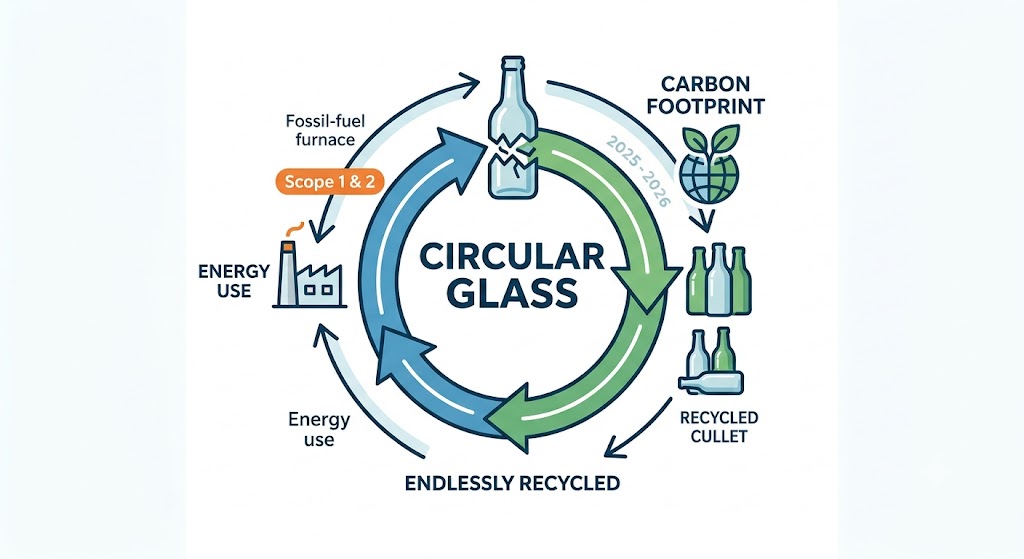
Permanent material is the single best phrase to describe glass, a substance that can be recycled endlessly without any loss in quality or chemical purity. Yet, despite its perfect circular credentials, producing glass remains a highly carbon-intensive business. Conventional glass melting relies on fossil-fuel combustion in massive, energy-heavy furnaces, contributing roughly 2.6% of all global industrial CO2 emissions. Today, as global supply chains face mounting pressure to address Scope 1, Scope 2, and Scope 3 emissions, glass manufacturers are caught in a tight spot. To stay competitive in the 2025–2026 market, factories must find realistic ways to reduce energy use, integrate more recycled cullet, and lower carbon footprints without sacrificing product quality. This means that every scrap of discarded glass must be successfully recovered and recycled back into the loop, maintaining its status as a premier permanent material in the global circular economy.
Reinventing a Permanent Material: How AI and Digital Twins Optimize Melting
Melting raw materials represents the biggest energy sink in a glass plant, swallowing over half of its total energy budget. Because molten glass behaves unpredictably under extreme furnace temperatures, operators have traditionally relied on manual experience to manage the process. However, this hands-on approach is highly risky when plants try to switch to low-carbon alternative fuels, such as hydrogen or biofuels, or implement electric boosting systems.
To solve this physical challenge, the UK research center Glass Futures teamed up with industry partners in 2026 to launch a physics-informed digital twin of its multi-fuel pilot furnace in St Helens. Supported by a £1.5 million grant from Innovate UK under the “Made Smarter UK” program, the “AI-GLASS” project brings together computing power from NVIDIA and virtual reality models designed by the University of Liverpool’s Virtual Engineering Centre (VEC).
What makes this digital twin different from traditional data models is its integration of fundamental physical laws. Instead of relying purely on historical statistics, its neural network architecture processes real-time sensor data—like temperature, pressure, and density—through 11,530 concurrent thermodynamic and fluid dynamic calculations. This physics-backed model gives operators a safe testing environment to optimize how this permanent material is heated and formed.
With this tool, engineers can run virtual, zero-risk trials using green hydrogen blends, alternative biomass fuels, or different electrode placements. This predictive capability lets plants verify their glass quality and furnace integrity before committing to expensive physical alterations. In addition to helping build new hybrid systems, the technology helps legacy plants digitize their existing analog systems, using AI to extend the operational life of current equipment without requiring a complete rebuild.
On the factory floor, AI-enabled process monitoring is also driving daily efficiency. Plants are increasingly deploying machine learning models, such as K-Nearest Neighbors (kNN) and Local Outlier Factor (LOF), to monitor real-time sensor data and identify equipment anomalies before they lead to failures. By flagging minor temperature drifts or draft pressure changes, these systems help automated control loops maintain stable combustion, cutting down on fuel waste, avoiding manual errors, and maintaining the quality of this permanent material.
Electrification and Recycled Cullet: Decarbonizing a Permanent Material
Meeting long-term net-zero goals by 2050 requires a complete overhaul of furnace energy sources and raw materials. Because of this, the industry is moving away from traditional fossil-fuel melting and toward hybrid and fully electric furnaces.
When electric melting is paired with renewable energy grids, it can directly cut Scope 1 emissions by 50% to 80%. For example, Libbey is currently replacing four traditional regenerative furnaces at its plant in Toledo, Ohio, with two hybrid electric furnaces. This shift is designed to run on up to 80% renewable electricity and 20% gas, cutting direct emissions by 60%. Similarly, the US Department of Energy (DOE) is working with the Glass Manufacturing Industry Council (GMIC) on an advanced electric melting project designed to test commercial systems capable of reducing Scope 1 greenhouse gas emissions by more than 85%.
At the same time, maximizing recycled glass (cullet) usage is a major operational priority. Thermodynamically, every 10% increase in cullet reduces furnace melting energy by roughly 3% and direct CO2 emissions by 7%. However, running high-recycled batches poses serious practical challenges. In the US, municipal sorting systems remain highly inefficient, keeping glass recovery rates at a mere 30%. Furthermore, when cullet concentrations reach high levels (such as 70%), contaminants like metals or ceramics can cause severe blistering and “foaming” in electric furnaces, halting production.
Despite these hurdles, major manufacturers are pushing forward with localized strategies. Portugal’s BA Glass group leveraged Romania’s Deposit-Return System (DRS) to dramatically boost high-quality cullet recovery, while also substituting natural gas with biomethane to cut 1,500 tonnes of emissions at one of its plants. Yet, the transition remains challenging. Volatile fuel markets and shifting demand forced the group to close its single-furnace facility in Athens in 2024, and a furnace leak at its Avintes plant led to a disruptive fire—reminding the industry of the delicate balance between pushing equipment limits and maintaining basic operational safety.
Even auxiliary components are being targeted for carbon reductions. Companies are increasingly adopting synthetic ester-based biodegradable lubricants for packaging and forming machinery. These biodegradable products reduce mechanical friction and wear, outlast mineral oils, and eliminate the volatile emissions that compromise indoor air quality and worker safety.
| Decarbonization Pathway | Key Implementers | Performance Metrics | Technical & Supply Chain Bottlenecks |
|---|---|---|---|
| Hybrid Electric Furnaces | Libbey (Toledo, Ohio), BA Glass ECO Furnace | Up to 80% electricity input, 20% gas; cuts direct emissions by 50% to 60% | Managing thermal shock and wear on refractory linings during electric transitions. |
| Fully Electric Furnaces | Verallia (Cognac plant), US DOE Electric Melting project | 100% powered by electrodes; zero flue gas emissions; slashes Scope 1 carbon by 60% to 85% | Requires massive renewable grid hookups; high risk of electrode wear and glass foaming with high cullet. |
| High-Ratio Recycled Cullet | Gallo Glass, NSG Group (renew:glass initiative) | Every 10% cullet lowers melting energy by 3% and CO2 by 7%; avoids landfilling | Inefficient sorting in municipal waste streams; high risk of batch contamination. |
| Biomethane & Alternative Fuels | BA Glass (Romania facility) | Substituted gas with biomethane, cutting single-plant emissions by ~1,500 tonnes | Scarce commercial supply of green hydrogen and biomethane; fuel switching risks localized burner overheating. |
ResponsibleGlass: A Global Standard for Verifying Glass as a Permanent Material
As international brands demand lower carbon footprints, the lack of an independent, globally recognized standard for sustainable glass has created confusion for architects, automotive buyers, and food packers. In response, a coalition of major industry players launched the “ResponsibleGlass” initiative.
Backed by organizations like the NSG Group, WE Soda, Arup, and Glass Futures, the program is establishing the first independent framework to verify this permanent material globally. Unlike steel or timber, the glass sector has historically lacked a unified certification system. ResponsibleGlass aims to change this by launching its Version 1.0 standard in late 2026, which will provide a practical blueprint for responsible manufacturing.
The standard evaluates the entire supply chain, assessing greenhouse gas emissions, worker safety, raw material extraction (such as sustainable soda ash mining), and the use of post-consumer cullet. Once implemented, this certification will become a key tool for buyers, effectively making independent verification a baseline requirement for high-end automotive, construction, and packaging markets.
Valiant‘s Pragmatic Approach to a Permanent Material: Customization and Lightweighting
While high-tech chip packaging and multi-million-pound furnace replacements make great headlines, they do not always match the practical needs of mid-sized B2B buyers. For Valiant , a specialized supplier of glass bottles for global spirits, wine, and beverage brands, the goal is simpler: delivering reliable, high-quality packaging that helps customers meet their commercial and environmental targets.
We believe that B2B packaging doesn’t need to be overly complicated to make glass a successful permanent material choice. By focusing on practical, reliable manufacturing at our facility in Shandong, China’s daily-use glass production hub, we offer direct value to our global clients:
- Low MoQs & Structural Sample Testing: Many premium brands want to test new products without committing to massive production runs. Valiant holds over 3,000 existing molds, allowing us to offer flexible ordering—from 1,000 to 5,000 units for stock items and custom runs starting at just 6,000 units. Our in-house CAD/CAM team can quickly draft structures and produce physical glass samples, letting you test product compatibility and label fitting before mass production begins.
- Weight Reduction via Press and Blow: High-end spirits often use thick-bottomed, heavy bottles to project quality, but shipping heavy glass increases logistics costs and transportation emissions. Valiant has refined the “Press and Blow” glass forming technique. This process ensures precise glass distribution, allowing us to thin out the sidewalls and reduce total bottle weight by 15% to 25% without losing the heavy, high-end physical presence of this permanent material. This lightweight design cuts raw material consumption and directly lowers Scope 3 shipping costs and emissions.
- Tangible, Clean Energy Sourcing: Instead of relying on abstract carbon offsets, Valiant has invested in its local energy infrastructure. Our melting furnaces run on clean, low-sulfur natural gas over 90% of the time, and several are equipped with electric boosting systems to maximize thermal efficiency. We have installed a 5 MW rooftop solar system and an 8.4 MW wind power installation directly at our manufacturing facilities, utilizing local clean energy to power our lines and lower Scope 2 grid emissions. We also maintain consumer PCR (Post-Consumer Recycled) sorting structures to feed recycled glass directly back into our batches.
- One-Stop Finishing and Decoration: To eliminate shipping delays and quality issues from third-party handlers, Valiant manages all finishing processes in-house. Our fully electric baking kilns support silk-screen printing, spray coating, frosting, embossing, and hot foil stamping. All of our facilities are ISO 9001, 14001, and 45001 certified, and our products are thoroughly tested to meet FDA and EU food-contact standards.
By focusing on realistic lightweighting, flexible ordering, and clean, solar-supported production, Valiant helps brands meet their environmental goals while keeping their supply chains highly efficient and cost-effective.