

Table of Contents
Classifying and Understanding Glass Production Defects
The physical chemistry behind Glass Production Defects is highly complex, involving solid stones, gaseous bubbles, optical cords, and mechanical checks. Because glass is a brittle material with poor toughness, surface and internal Griffith flaws generate severe stress concentrations under external loads. This causes the actual tensile strength to drop several orders of magnitude below the theoretical molecular bond strength of 10 GPa. Therefore, statistical quality control like Weibull statistics is essential to analyze pre-existing cracks and predict unpredictable fracture behaviors.

Lab Diagnostics & Furnace Erosion
Accurate defect tracing relies on micro-area phase profiling and gas-phase mass spectrometry. Solid stones primarily originate from the high-temperature erosion of furnace refractories such as fused-cast AZS. SEM-EDS cross-sectional imaging reveals characteristic mineral phases—primary baddeleyite (ZrO₂), rounded tabular corundum (Al₂O₃), and skeletal secondary baddeleyite—proving origins from the AZS refractory zone. For gas inclusions, residual gas mass spectrometry (RGA-MS) breaks samples under ultra-high vacuum to analyze residual species (CO₂,SO₂, N₂, Ar), distinguishing between refining reactions, electrochemical electrode reactions, or atmospheric air entrapment indicated by an SO₂/Ar ratio near 84.
Hot-End Forming Control and 3D Metrology
Machine Vision and Intelligent AI Systems
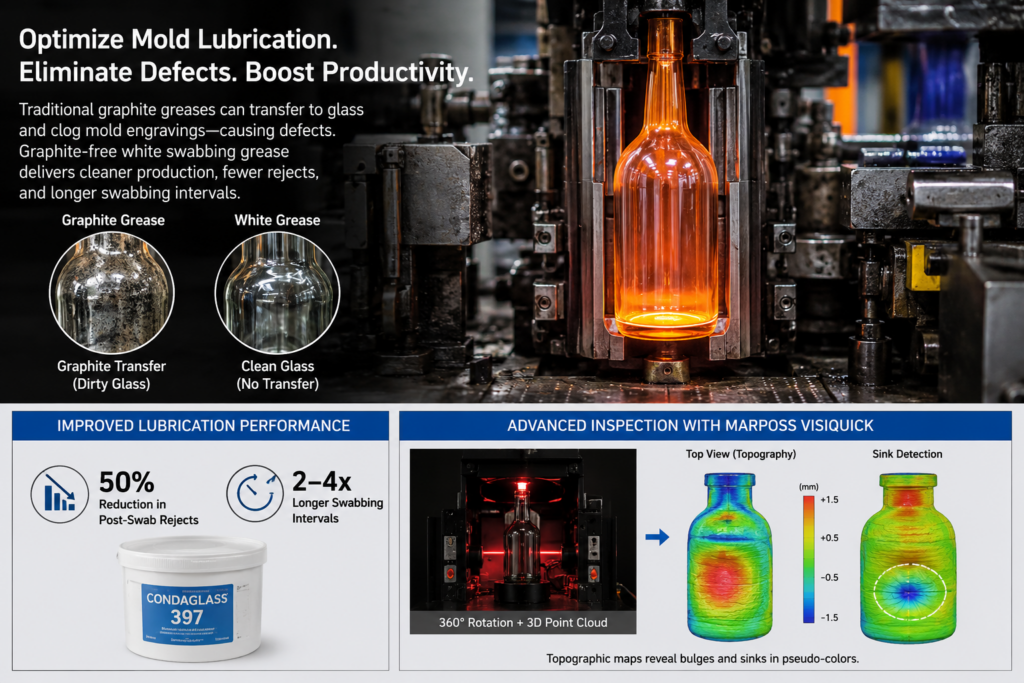
Optimizing mold physical lubrication is critical to preventing surface-level Glass Production Defects during the hot-end forming stage. Traditional graphite greases cause graphite transfer (dirtying the items) and build up in fine engravings, preventing proper glass distribution and causing crizzle or checks. Transitioning to graphite-free “white swabbing grease” (such as Condaglass 397) provides exceptional release properties, slashing post-swab rejects by 50% and extending swabbing intervals by two to four times. Furthermore, in labeling-area inspection, traditional shadow-casting methods fail to detect inward-collapsing deviations (sinks). Marposs’s VisiQuick system rotates the container 360 degrees and utilizes 3D point cloud reconstruction to generate topographic maps displaying bulges and sinks in pseudo-colors.
Modern artificial intelligence (AI) has revolutionized how factories identify and classify Glass Production Defects at the cold end. Conventional vision algorithms rely on hard-coded thresholding, leading to false reject rates up to 3% due to reflections and complex embossing. Modern AI platforms, like BEG HEAT and Iris EVOLUTION NEO AI, leverage massive unlabeled databases for self-supervised pre-training to comprehend the physical principles of glass optics. For critical issues like “bird swings” or complex thread chips, generative AI expands training sets, enabling the system to classify over 30 defect categories in milliseconds, eliminating reflective noise and lowering false rejects by up to 3%.
Conclusion
In conclusion, modern glass plants must establish a multi-disciplinary closed-loop control system to systematically minimize Glass Production Defects. This integration of lab phase-chemical tracing, hot-end material optimization, and cold-end self-supervised AI not only helps achieve Six Sigma quality goals but also secures production efficiency as the industry adapts to deep decarbonization challenges like full electric melting and hydrogen combustion.
Specifically, the future of managing Glass Production Defects will heavily rely on combining real-time environmental monitoring with advanced multi-spectral sensor arrays. This deep technological integration enables modern manufacturing plants to dynamically adapt to thermodynamic fluctuations inside the melting furnace before structural anomalies fully crystallize. Furthermore, by pairing virtual container forming computer simulations with real-time edge AI analytics, operators can accurately predict stress concentrations in the bottle wall before the molten glass even enters the blow molds. Ultimately, transitioning from passive defect detection to predictive, AI-driven prevention remains an indispensable, highly effective strategy to protect brand reputation, eliminate expensive product recalls, and maintain long-term industrial competitiveness in a demanding, carbon-neutral global market. This paradigm shift ultimately guarantees safety, maximizes total yield.