
Table of Contents
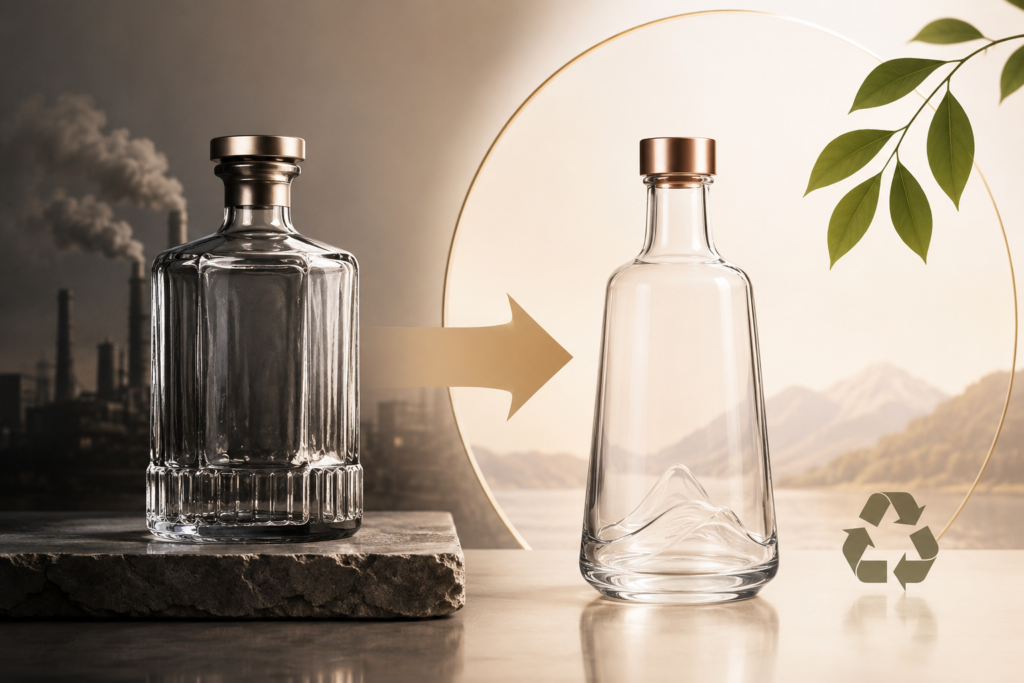
In the 2026 global beverage and packaging market, the rapid rise of lightweight glass bottles is driving a profound transformation that reshapes the relationship between packaging aesthetics and commercial profitability for spirits brands. For decades, the spirits industry was dominated by the traditional mindset of “heavier means more premium,” where thick bases and heavy glass walls served as the ultimate shorthand for luxury and exclusive status. However, with global supply chain costs fluctuating wildly, environmental regulations tightening, and consumer behaviors shifting, this old rulebook is being rewritten. Today, “Lightweight Luxury” has evolved from a niche sustainability trend into a strategic business necessity for spirits brands in 2026.
The global alcoholic beverage glass packaging market is experiencing robust growth, with its valuation projected to rise from USD 45.80 billion in 2026 to USD 64.91 billion by 2035, growing at a CAGR of 3.65%. A key driver behind this expansion is the explosive demand for green manufacturing, high recycling rates, and lightweight glass bottles across all beverage categories. For spirits brands striving to stand out in a crowded market, adopting lightweight glass bottles is the ultimate win-win—enabling them to dramatically slash logistics and production costs while building a powerful, eco-conscious brand identity.
The Packaging Revolution: From “Heavy Luxury” to “Lightweight Luxury”
The global spirits market is undergoing a structural transition. According to the latest market data, consumers are showing a clear preference for “selective premiumization”. Younger generations, particularly Gen Z, are actively turning away from traditional luxury tropes—such as heavy, dark glass bottles, imposing serif typefaces, and austere color palettes that once symbolized exclusivity. Instead, they gravitate toward minimalist, modern packaging that carries authentic environmental and social responsibility.
Additionally, glass packaging faces technical competition from alternative materials. The explosive rise of ready-to-drink (RTD) cocktails (with North American RTD volumes expected to grow by 400% by 2029) has popularized lightweight aluminum cans. Elsewhere, eco-innovative formats are capturing attention:
- Paper Bottles: Distillery 98’s Half Shell Vodka utilizes a paper bottle made of 94% recycled paperboard with a food-grade inner pouch, making it 5 times lighter than glass.
- Aluminum Bottles: Element[AL] introduced sleek aluminum bottles that are 80% lighter than standard empty glass bottles when full.
- rPET Bottles: Blue Bin Wines launched 100% recycled rPET bottles weighing just 52 grams.
However, glass remains irreplaceable for premium spirits. Its exceptional barrier properties preserve delicate flavors, prevent contamination, extend shelf life, and maintain an unparalleled sense of premium artistry. Spirits brands cannot simply abandon glass; instead, the path forward lies in utilizing advanced engineering to right-weight their packaging, transforming lightweight glass bottles into the modern vessel of sustainable premium luxury.
NNPB Technology: Engineering Strength into Thin Glass
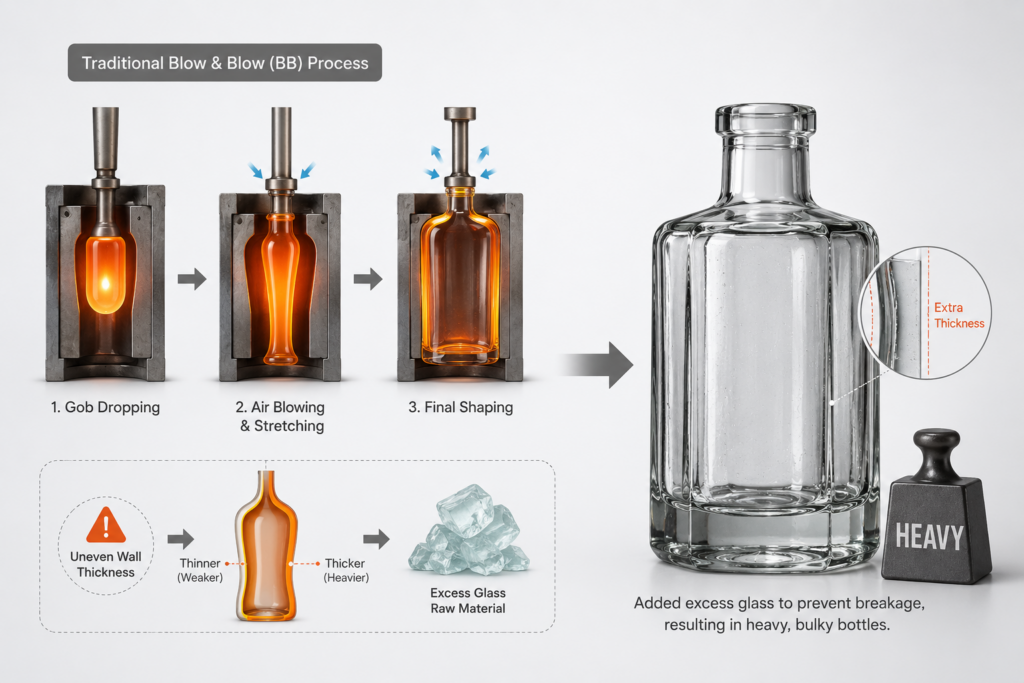
In the traditional Blow & Blow (BB) process, molten glass gobs are stretched using compressed air. Because air pressure cannot be perfectly controlled, this method often results in uneven wall thickness. To ensure that the thinnest parts of the bottle do not shatter under vertical loads or during high-speed bottling, manufacturers have historically added excess glass raw material, resulting in heavy, bulky bottles.
In 2026, Narrow Neck Press and Blow (NNPB) technology has become the gold standard for manufacturing high-end, lightweight glass bottles. Unlike the BB method, NNPB uses a precise, mechanical metal plunger to press the glass parison before the final blowing stage. This ensures a highly uniform distribution of glass throughout the bottle, eliminating structural weak points.
The table below outlines the key differences between the industry’s three primary glass-forming processes:
| Forming Process | Technical Mechanism | Wall Uniformity | Applicable Neck Finish | Primary Applications | Pros & Cons |
| BB (Blow & Blow)[cite: 2, 3] | Dual compressed air stretching | Poor, high thickness variation with structural weak points | Narrow mouth | Ultra-premium spirits bottles with thick bases or complex embossing | Pros: Low mold costs, allows extra-heavy bottoms; Cons: Heavy bottle weight, high material consumption. |
| PB (Press & Blow)[cite: 2] | Mechanical metal plunger pressing | Excellent, highly uniform inner walls | Large diameter (Wide mouth) | Premium food jars, jam jars, candle cups | Pros: High clarity, easy cleaning; Cons: Limited to wide-mouth containers. |
| NNPB (Narrow Neck Press & Blow)[cite: 2, 3] | Precise thin plunger pressing | Extremely high, uniform wall thickness | Standard narrow mouth | Export-grade wine and lightweight spirits bottles | Pros: Redundant weight cut (average 14%) while keeping high strength; Cons: Strict temperature control needed, hard to produce very heavy bases. |
Finite element analysis (FEA) proves that when wall thickness is uniform, overall bottle weight can be reduced by approximately 14% while maintaining or even exceeding the pressure and load resistance of traditional heavy bottles. Advanced inspection devices from manufacturers like Toyo Glass and Heye International feature online laser thickness detection and stress analysis, guaranteeing near-zero defect rates on high-speed filling lines.
Supply Chain Optimization: Logistics & Financial Dividends
Transitioning to lightweight glass bottles directly restructures a brand’s supply chain economics. Intercontinental and long-haul shipping routes are tightly constrained by vehicle payload limits.
- Optimizing Container Payload and Volumetric Efficiency: Reducing a standard 750ml bottle from 500g to 360g allows exporters to load 15% to 20% more product per shipping container on weight-restricted routes. This payload optimization resulted in an average 12% lower logistics cost in Q4 2025 compared to utilizing heavy bottles.
- Palletizing Efficiency: Standard heavy glass bottles are bulky and require extensive protective dividers, meaning a standard pallet can usually only hold around 60 cases of product. In contrast, sleek and compact lightweight glass bottles can be packed far more tightly, allowing up to 105 cases per pallet, which significantly lowers warehousing and handling costs.
- Bottling Line Performance: Lightweight glass bottles treated with polymer scratch-resistant surface coatings distribute mechanical stress evenly, which significantly reduces bottle-to-bottle impact breakage on high-speed bottling lines.
Regulations and ESG Mandates: The Compliance Push
In 2026, global environmental compliance is no longer a marketing option but a legal mandate. In Europe, the EU Packaging and Packaging Waste Regulation (PPWR) has set strict targets for packaging reduction and recyclability. The European Container Glass Federation (FEVE) has stated that adopting lightweight glass bottles is the primary technical pathway for the glass industry to meet its 2030 decarbonization goals. Concurrently, the finalization of the EU Carbon Border Adjustment Mechanism (CBAM) imposes heavy carbon taxes on imported spirits that fail to adopt low-carbon manufacturing standards.
Monopoly distributors and retail giants are driving this shift. The Société des alcools du Québec (SAQ) mandated that all regular wine listings priced under $24.95 transition to lightweight glass bottles. By 2022, 84% of regular wines in Quebec had successfully transitioned, leading to up to a 25% reduction in life-cycle greenhouse gas emissions and a 27% reduction in packaging mass. Following this success, SAQ is actively expanding these weight-reduction directives to sparkling wine and spirits categories.
Industry-wide coalitions are solidifying this transition. The Sustainable Wine Roundtable (SWR) launched the Bottle Weight Accord (BWA) in late 2023, committing signatories to reduce the average weight of a standard 750ml still bottle to under 420g by the end of 2026. Today, the BWA covers over 20 global giants (including Tesco, Lidl, and Systembolaget), representing 2.5 billion bottles annually. SWR’s research in 2026 shows that many members’ bottles have already dropped to the 350g–370g range, with ultra-lightweight bottles as low as 300g entering mass circulation.
Global Spirits Giants Leading the Lightweight Revolution
To dismantle the consumer myth that “heavy glass equals premium quality,” leading global spirits brands have introduced groundbreaking lightweight packaging designs.
Partnering with Valiant Glass: Your Strategic Gateway to Lightweighting in 2026
As spirits brands navigate the tightrope between sustainability mandates and premium shelf presence, partnering with a forward-thinking glass manufacturer is critical. Valiant Glass has emerged as the premier choice for global liquor brands, offering a seamless transition to eco-friendly, lightweight packaging through advanced manufacturing and end-to-end customization.