
Table of Contents
Meta Description:
Explore the most powerful Glass Bottle Sizes for spirits and liquor brands, including 50ml to 1750ml options, and learn how bottle size impacts branding, cost, and market performance.
In today’s highly competitive spirits industry, packaging has evolved into a strategic marketing asset rather than a simple container. The selection of appropriate Glass Bottle Sizes plays a decisive role in how a brand is perceived, how efficiently products are distributed, and how effectively a product performs in retail and export markets. For whisky, vodka, rum, tequila, and other liquor categories, bottle sizing directly influences consumer psychology, pricing structure, and brand positioning.
Modern liquor brands are no longer relying on a single standardized approach. Instead, they carefully evaluate multiple packaging capacities to align with different distribution channels, from duty-free stores and premium retailers to promotional campaigns and hospitality services. This flexibility allows brands to expand reach while maintaining consistency in identity and quality perception.
The importance of Glass Bottle Sizes also extends to manufacturing efficiency and transportation optimization. Larger bottles reduce per-unit packaging costs, while smaller bottles improve sampling strategies and entry-level consumer engagement. According to Grand View Research, demand for premium and diversified spirit packaging formats continues to rise globally, especially in emerging markets.
Strategic Importance of Glass Bottle Sizes in Spirits Packaging
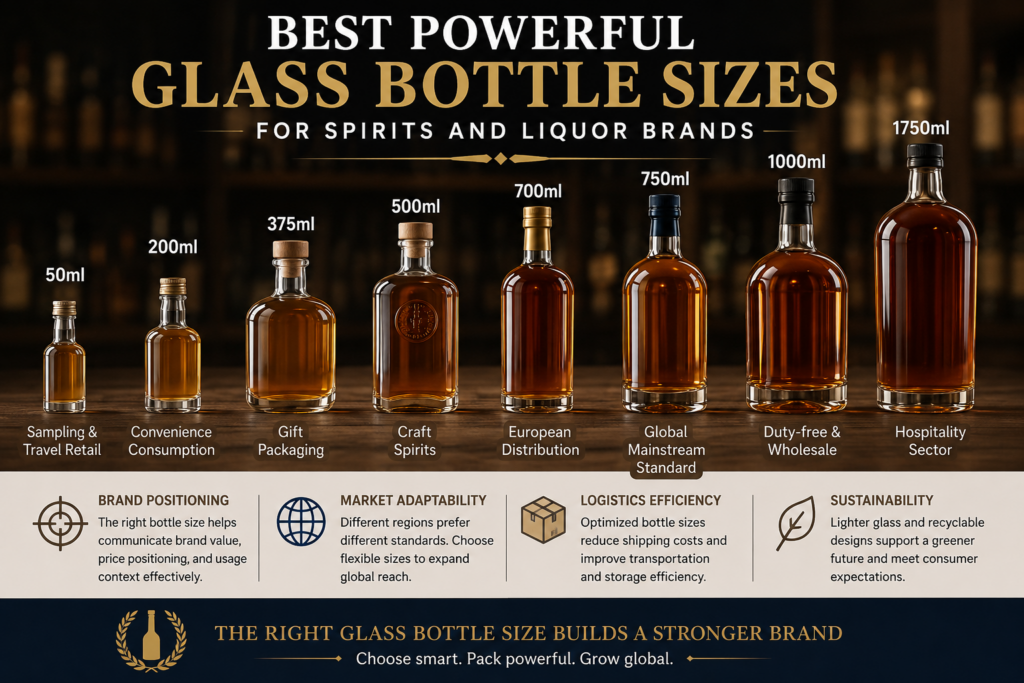
The strategic value of bottle sizing is rooted in consumer behavior and brand storytelling. A 750ml bottle often communicates standard premium quality, while smaller formats such as 50ml or 200ml suggest accessibility and experimentation. Larger formats such as 1000ml or 1750ml typically signal value efficiency and are widely used in commercial or hospitality environments.
Brands that understand packaging strategy are able to tailor their products to specific consumption contexts. For example, a luxury whisky brand may use heavier glass and a 750ml format to reinforce exclusivity, while a craft distillery may introduce multiple formats to encourage trial and discovery.
Market Distribution Overview
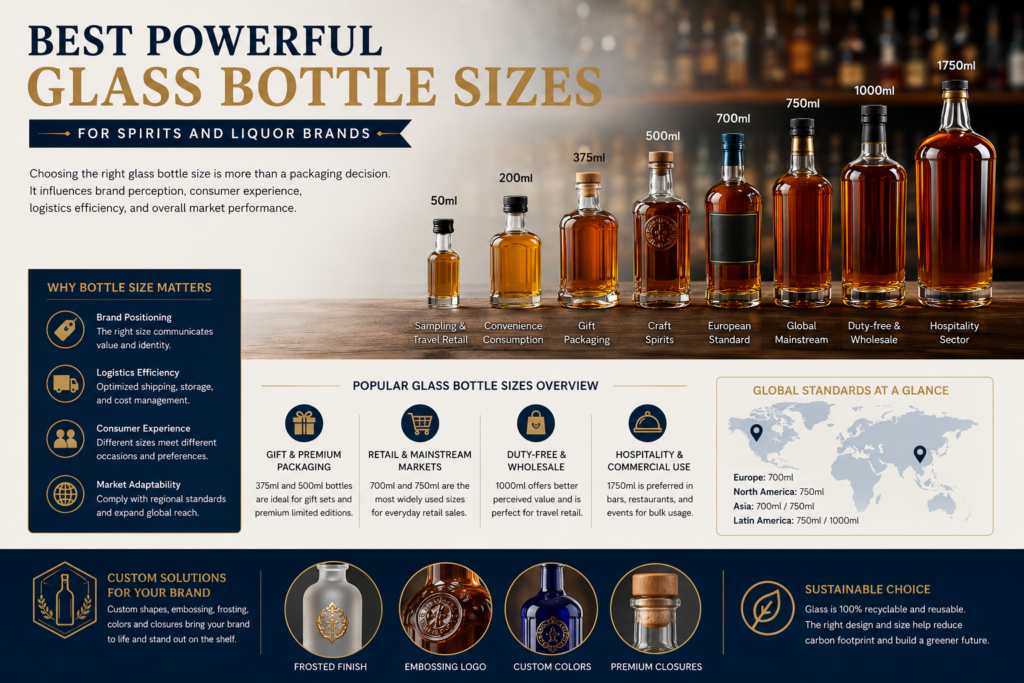
The global spirits market demonstrates clear segmentation in preferred bottle capacities, influenced by regional regulations, cultural consumption habits, and retail structures. The table below illustrates common industry applications.
| Size | Market Application | Strategic Advantage |
| 50ml | Sampling and travel retail | Low-risk trial introduction |
| 200ml | Convenience consumption | Easy accessibility |
| 375ml | Gift packaging | Perceived exclusivity |
| 500ml | Craft spirits | Differentiated positioning |
| 700ml | European distribution | Export compatibility |
| 750ml | Global mainstream standard | Balanced branding and volume |
| 1000ml | Duty-free and wholesale | Higher value perception |
| 1750ml | Hospitality sector | Cost-efficient bulk usage |
Across all categories, 750ml remains the dominant global standard for whisky, vodka, and rum brands due to its balance between volume, pricing psychology, and logistics efficiency.
Brand Positioning Through Glass Bottle Sizes
Effective brand positioning is deeply connected to packaging capacity selection. Smaller formats serve as entry points for new consumers, reducing purchase hesitation. Mid-range formats are commonly used to build long-term recognition and shelf presence
Premium brands often integrate custom molding and design elements to enhance visual identity. This includes heavier bases, embossed logos, and unique silhouettes that differentiate products in saturated retail environments. Craft producers, on the other hand, often experiment with alternative sizing strategies to create niche appeal and storytelling differentiation.
For professional manufacturing solutions, customized packaging development can be explored through VALIANT Glass Bottles.
Internal Branding Strategy
From a branding perspective, packaging capacity is closely tied to storytelling and consumer experience. It is often the first physical interaction a consumer has with a product, and it signals quality, price positioning, and usage context.
Brands align marketing narratives with packaging formats to reinforce identity. A premium tequila line may emphasize its 750ml presentation as the “perfect balance of tradition and modern luxury,” while a craft rum brand may highlight smaller formats as a distinctive artisanal choice.
The Glass Packaging Institute also provides useful industry insights regarding sustainable and compliant glass packaging solutions.
Conclusion
The selection of Glass Bottle Sizes is a critical strategic decision for spirits and liquor brands. It influences branding, logistics, consumer behavior, and international market access. From small promotional formats to global standard bottles, each category serves a specific role in the overall business ecosystem.
Brands that strategically manage multiple packaging formats are better positioned to adapt to diverse markets, improve consumer engagement, and enhance long-term competitiveness. As the spirits industry continues to evolve, optimized bottle sizing will remain a key driver of packaging innovation. For more insights on global packaging trends and industry data, you can refer to Statista Spirits Packaging Insights, which provides updated market analysis and consumption trends across global spirits categories.
Leave a Reply