
Table of Contents
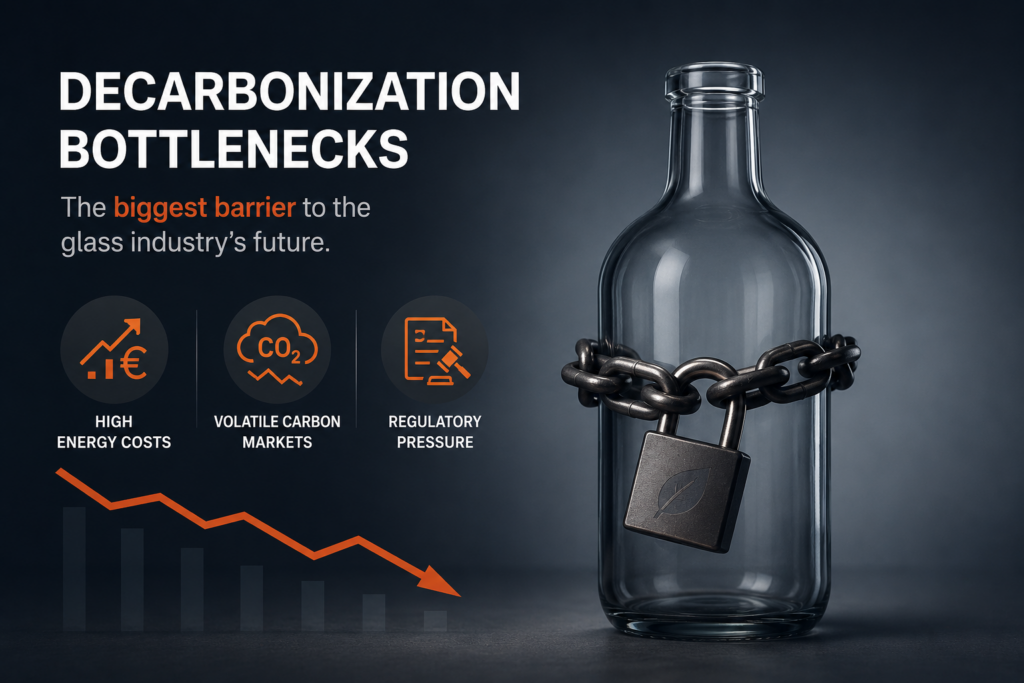
Decarbonization bottlenecks currently represent the most critical barrier to the survival and structural reorganization of the European glass manufacturing sector. As a highly energy-intensive industry, the sector is heavily pressured by high energy costs, volatile carbon market conditions, and regulatory mandates under the EU Emissions Trading System (ETS). Industry leaders in Brussels have warned of a dire situation marked by declining demand, stalled investment, and a shrinking domestic manufacturing base, forcing multiple plant closures since the start of 2025.
This industrial contraction is reflected in recent market monitoring, showcasing how severe these decarbonization bottlenecks have become. Plant closures across European energy-intensive sectors have surged sixfold since 2022, wiping out 37 million tonnes of production capacity—representing approximately 9% of total European output. This massive capacity shakeout has led to 20,000 direct job losses, putting tens of thousands of downstream positions at high risk. This trend highlights the extreme competitiveness gap facing European glass producers relative to international competitors operating under far lower regulatory and energy cost burdens.
The table below outlines the core pressure indicators and baseline structural metrics shaping the European glass landscape under its carbon-neutrality transition.
| egment | Baseline & Jobs | Stress & Capacity Losses | Policy Challenges |
| Flat Glass | 48 ETS-covered installations in 12 countries producing 10 million tonnes annually; 16,000 direct jobs. | High “lock-in” risk due to the continuous 16-20 year investment and operational cycles of float furnaces. | Free carbon allocations are set to deplete post-2030; no commercial technology exists globally to meet the 76% reduction target for 2040. |
| Container Glass | Produces approximately 24.5 million tonnes (95.3 billion units) annually, forming the backbone of pharma and food packaging. | Heavy transition stress driven by the EU Packaging and Packaging Waste Regulation (PPWR), mandating 10% reuse by 2030 and 40% by 2040. | Rebuilding low-carbon furnaces costs 2 to 5 times more than traditional rebuilds; grid capacity and green energy infrastructure are highly constrained. |
| Machinery & Base | Total sales in glass processing technologies have surpassed 3 billion euros, with Italy maintaining a strong competitive edge. | Plant closures have risen sixfold since 2022, eliminating 9% of total European manufacturing capacity. | Downstream glass products are excluded from CBAM in the short-to-medium term, allowing carbon-heavy imports to enter the market. |
Decarbonization Bottlenecks and the Reality of Capacity Shocks
To survive the decarbonization transition, major European glass manufacturers and engineering partners are launching a wave of reconstruction (“rebuilding”) projects. These initiatives aim to fundamentally overhaul furnace geology, scale up alternative thermal energies, and restructure localized supply networks.
Schott AG has pioneered carbon-neutral specialty glass melting at its Mainz headquarters, supported by public funding and regional utility partnerships. To optimize its logistics and supply chain across Central and Eastern Europe, Schott is also expanding a 30,000-square-meter facility in Iasi, Romania, integrating glass processing and intralogistics to mitigate logistical decarbonization bottlenecks.
In the container glass sector, Vidrala is driving the Castellar Vidrio decarbonization project in Spain. Vetropack has focused on its sustainable plant in Boffalora sopra Ticino, Italy, alongside a state-of-the-art waste glass treatment plant in Croatia to boost regional circularity and relieve supply chain friction.
In the packaging and specialty sector, French cosmetic glass manufacturer Pochet du Courval has successfully put its furnace 5 back into operation after a complete rebuild using Horn Glass equipment. Stoelzle Oberglas completed a 22 million euro modernization of its flint glass manufacturing line in Austria to capture high-value pharma and cosmetic packaging markets. Meanwhile, O-I Glass is upgrading its Gironcourt facility in France through a 60 million euro investment to support three furnaces and nine lines, and the Srpska glass factory in Paracin, Serbia, has completely rebuilt its B1 furnace and Line 5 with Bucher Emhart Glass (BEG), boosting daily capacity from 70 to 230 tonnes.
Geopolitical Hedge and Full Value Chain Rebuilding: Solar and Defense Warnings
Beyond its traditional uses in architecture and packaging, glass has evolved into a vital strategic asset closely tied to European economic security and energy independence, pointing to wider macroeconomic decarbonization bottlenecks.
1. Solar PV and Europe’s Strategic Autonomy
Under the Net-Zero Industry Act (NZIA), the EU aims to scale solar PV capacity from 263 GW today to almost 600 GW by 2030. Currently, however, over 95% of solar panels and critical solar glass are imported from China, which controls the vast majority of global manufacturing scale.
Glass for Europe has warned that rebuilding European solar manufacturing must avoid becoming a “simple assembly” of imported components. Securing energy and strategic autonomy requires a comprehensive “full value chain approach” that fosters a level playing field for domestic solar glass producers through anti-dumping reviews, local content rules, and the Net-Zero Industry Act (NZIA).
2. Defense and Reconstruction
The wars in Ukraine and the Middle East have underscored that modern conflict is an industrial test of endurance. Rebuilding Europe’s defense industrial base requires stable supplies of specialized optical, high-strength laminated, and protective glass. Furthermore, reconstructive planning in Ukraine represents a massive test of industrial endurance; rebuilding shattered real estate will create a severe deficit in float and architectural glass that European manufacturers must prepare to satisfy.
Strategic Conclusions: Valiant’s Grounded Path Through Decarbonization Bottlenecks
Rebuilding Europe’s glass manufacturing sector is no longer a simple exercise in furnace maintenance; it is a complex industrial challenge involving green policy, capital allocation, labor rights, and geopolitical resilience. In this transition landscape, global partners like us at Valiant Glass (Valiant Packaging) are demonstrating a pragmatic, step-by-step approach to bypassing structural decarbonization bottlenecks.
Rather than chasing unviable, overly hyped laboratory technologies that complicate production and drive up capital costs, Valiant focuses on practical, high-end sustainable craftsmanship. Based in Shandong with over twenty years of expertise, Valiant has systematically optimized its manufacturing footprint. By implementing realistic smart-manufacturing upgrades and focusing heavily on lightweight glass bottle designs, we reduce material consumption and furnace energy draw while preserving the premium tactile feel and high visual weight required by premium global spirits and wine brands. Furthermore, Valiant’s vertically integrated, eco-friendly post-processing capabilities—including water-based screen printing, organic spray coating, and specialized acid etching—allow brands to hit strict Scope 3 ESG targets without relying on unproven, capital-intensive furnace overhauls.
To preserve the global glass industry as a sustainable, strategic asset, policymakers, manufacturers, and partners like Valiant must align on three core directives to systematically eliminate current decarbonization bottlenecks:
Shift Competition to Pragmatic, High-Value, and Ecologically Transparent Products: Instead of competing purely on low-cost volume or waiting for a single miracle technology to solve all emissions, glassmakers must embrace Valiant’s philosophy: focusing on highly customizable, premium, and resource-efficient packaging. Through optimized mold design, physical lightweighting, and transparent supply chain reporting, global glass manufacturing can build a highly resilient, low-carbon future.
Overhaul Regulatory Frameworks to Prevent Deindustrialization: The post-2030 EU ETS must protect capital-intensive industries characterized by 16-20 year investment cycles. Free carbon allocations must be maintained until the Carbon Border Adjustment Mechanism (CBAM) is fully expanded and proven to prevent indirect carbon leakage without harming downstream exports.
Prioritize Industrial Clean Energy Infrastructure: Governments must accelerate public investment in grid capacity, high-voltage industrial substations, and green hydrogen pipelines. Without a stable, affordable supply of zero-carbon power, the economic business case for hybrid and electric furnaces cannot be sustained.