
Abstract
3D printed glass is currently witnessing a paradigm shift in material science, as the centuries-old art of glassmaking intersects with the cutting-edge precision of additive manufacturing. Recent breakthroughs in this field, particularly between 2024 and early 2026, have successfully navigated the “thermal barrier” of silica processing, enabling the creation of complex glass geometries at significantly lower temperatures than traditional furnaces. This report analyzes the recent technological milestones in low-temperature glass synthesis, the transition toward binder-free sol-gel processes, and the strategic adoption of 3D printed glass elements by luxury spirits brands to achieve unprecedented levels of premiumization and sustainability. For the packaging industry, these advancements represent a fundamental shift from mass-produced, mold-constrained containers to a “Digital Vitrification” model—one that prioritizes structural lightweighting, sensory complexity, and supply chain agility. This analysis is directly relevant to Shandong Valiant Packaging’s mission to lead in innovation, offering a roadmap for integrating additive manufacturing into high-performance beverage packaging to meet the evolving demands of the European, American, and Southeast Asian markets.
The Technological Vanguard: Global Evolution of 3D Printed Glass
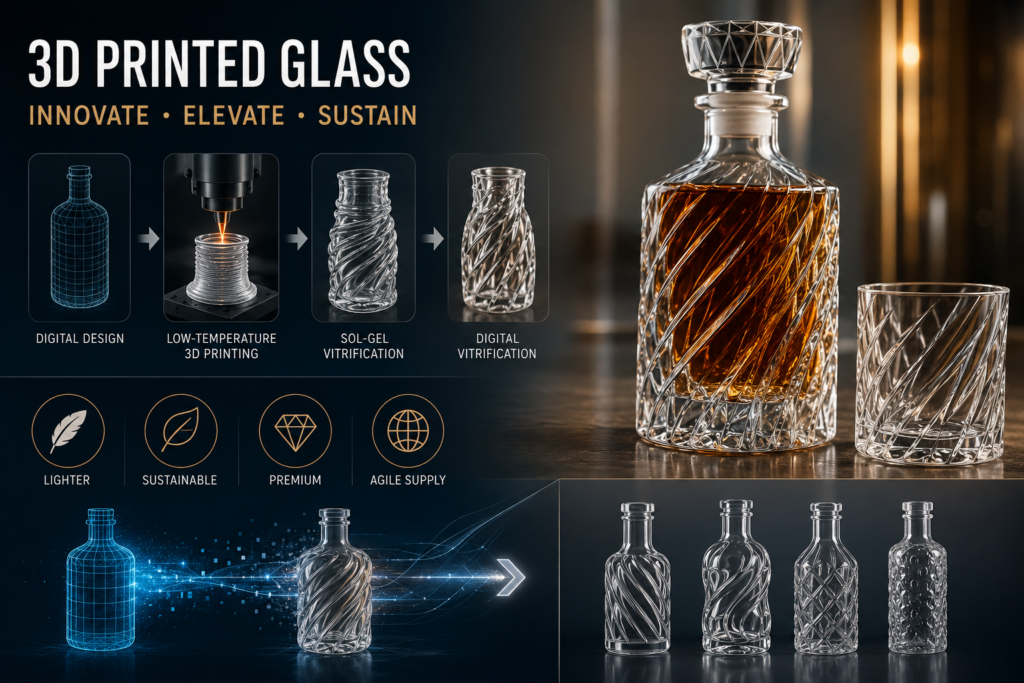
The landscape of 3D printed glass has undergone a radical transformation, moving from lab-based experimentation to industrial-scale viability. Central to this shift is the emergence of low-temperature processing techniques that bypass the traditional 1,000°C+ requirements of conventional glassmaking. In late 2024 and 2025, researchers at Yokohama National University in Japan introduced a revolutionary polyhedral oligomeric silsesquioxane (POSS)-based resin. This material allows for high-resolution printing of glass at temperatures between 650°C and 700°C, effectively reducing thermal energy consumption while simultaneously decreasing material shrinkage from the industry-standard 42% to a more manageable 36%. This technical milestone is complemented by the Hebrew University of Jerusalem’s development of a binder-free sol-gel method, which utilizes a photo-induced inorganic reaction to form silica structures without the need for organic additives. By curing objects at a mere 250°C, this process enables the creation of centimeter-scale silica components that maintain high geometric precision. Concurrently, the global 3D printed glass technology market is expected to reach $5 billion by 2030, with Asia-Pacific dominating the 3D printed packaging sector with a 43.28% market share in 2025.
Professional Interpretation: The Impact of 3D Printed Glass on Design and Sustainability
The professional interpretation of 3D printed glass technology centers on the erosion of the “Iron Triangle” of glass packaging—the historical struggle to balance structural strength, aesthetic complexity, and glass weight. Traditional glass containers are manufactured using rigid molds subject to physical constraints such as ejection angles and uneven glass distribution. 3D printed glass eliminates these constraints by shifting value creation from physical tooling to digital control. This allows for the integration of internal lattice structures and topology-optimized designs that can achieve a weight-to-volume ratio as low as 0.4, compared to the standard 0.5 for premium bottles. Such lightweighting slashes carbon emissions during transportation, as evidenced by luxury wine brands achieving over 20% weight reduction in their glass containers. Furthermore, in the luxury spirits sec tor, brands like Hennessy are using additive manufacturing to create “couture” packaging that mimics complex textures that traditional casting cannot replicate. For supply chain intermediaries, the rise of 3D printed glass suggests a transition to “Digital Inventory,” where digital files are printed on-demand, reducing warehousing costs and mitigating supply chain risks.
Strategic Recommendations: Integrating 3D Printed Glass at Valiant Packaging
Shandong Valiant Packaging is uniquely positioned to capitalize on 3D printed glass trends by leveraging its existing expertise in large-format metal additive manufacturing and applying those principles to the beverage sector. The most immediate and feasible innovation is the development of “Hybrid Manufacturing” workflows, using 3D printing to create “Smart Molds” with internal conformal cooling channels that allow for more uniform glass distribution and faster cycle times. Beyond mold optimization, Valiant should establish a “Digital Glass Lab” focused on luxury spirits, utilizing high-resolution sol-gel systems to provide clients with functional glass prototypes that match final product properties. For the Southeast Asian market, where Valiant maintains strong logistics, the company should deploy localized printing hubs in key markets like Singapore or Thailand. This localized approach reduces the carbon footprint of global shipping and provides an agile response to regional demands for personalized, high-status packaging. Finally, Valiant should invest in R&D for “Circular Feedstocks,” exploring the use of recycled glass cullet as a primary component for 3D printed glass filaments to align with global sustainability goals.
Conclusion and Outlook
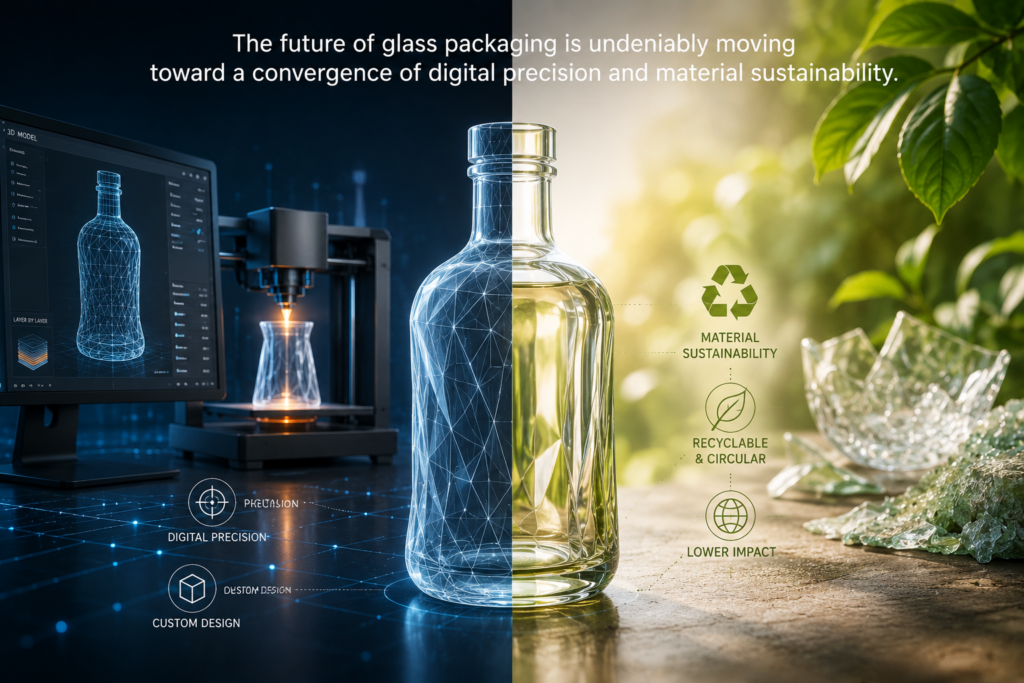
The future of glass packaging is undeniably moving toward a convergence of digital precision and material sustainability. The breakthroughs of 2024-2025 in 3D printed glass have dismantled the primary technical barriers to entry, making it possible to produce chemically inert and geometrically complex components that were once the domain of science fiction. As the global 3D printed packaging market continues its trajectory toward $2.16 billion by 2034, the adoption of these technologies will differentiate market leaders from traditional suppliers. For the packaging professional, the outlook is one of “Digital Vitrification,” where the bottle is no longer a mere commodity but a high-performance, data-integrated asset. Shandong Valiant Packaging must continue to lead this evolution by bridging its aerospace-grade additive manufacturing capabilities with its deep expertise in customization, setting the benchmark for the future of the global beverage packaging landscape.