
Abstract
As the global glass packaging market is projected to reach USD 78.6 billion by 2025, the industry faces an escalating “fragility gap” that threatens supply chain profitability. Transit-related damage to glass bottles currently costs the global manufacturing sector an estimated USD 4.7 billion annually. For the spirits, wine, and beer industries, glass remains the non-negotiable standard for premium branding; however, its inherent brittleness and high logistics costs—averaging 27% higher than plastic—demand a transition from passive containment to active, engineering-driven protection strategies. This article analyzes the technical causes of glass failure in transit and outlines strategic solutions for high-efficiency global distribution.
Global Logistics Realities: Data-Driven Impact Analysis
The economic ramifications of glass bottle breakage extend far beyond immediate product loss. Each breakage event triggers a costly chain reaction, including production delays, labor rescheduling, and rising insurance premiums, with the “true cost” of a single incident averaging USD 3,777. Industry data reveals that approximately 1 in 51 Less-than-Truckload (LTL) shipments are affected by damage. In long-haul maritime routes, breakage rates typically hover between 2% and 3%, while retail breakage in long-haul inland deliveries can reach as high as 4%. These losses are particularly acute in the craft spirits sector, where a 42.8% increase in licensed distilleries has driven demand for complex, often more fragile, bespoke bottle shapes.
| Market Metric | 2025/2026 Industry Benchmark |
| Global Glass Market Value (2025 ) | USD 78.6 Billion |
| Annual Loss from Shipping Damage | USD 4.7 Billion |
| Freight Cost Premium (vs. Plastic) | 27% |
| Average Sea Freight Breakage Rate | 2% – 3% |
| Retail Breakage (Inland Long-Haul) | 4% |
| Target Breakage Rate (Optimized) | <0.5% |
Professional Interpretation: The Science of Breakage and Structural Solutions
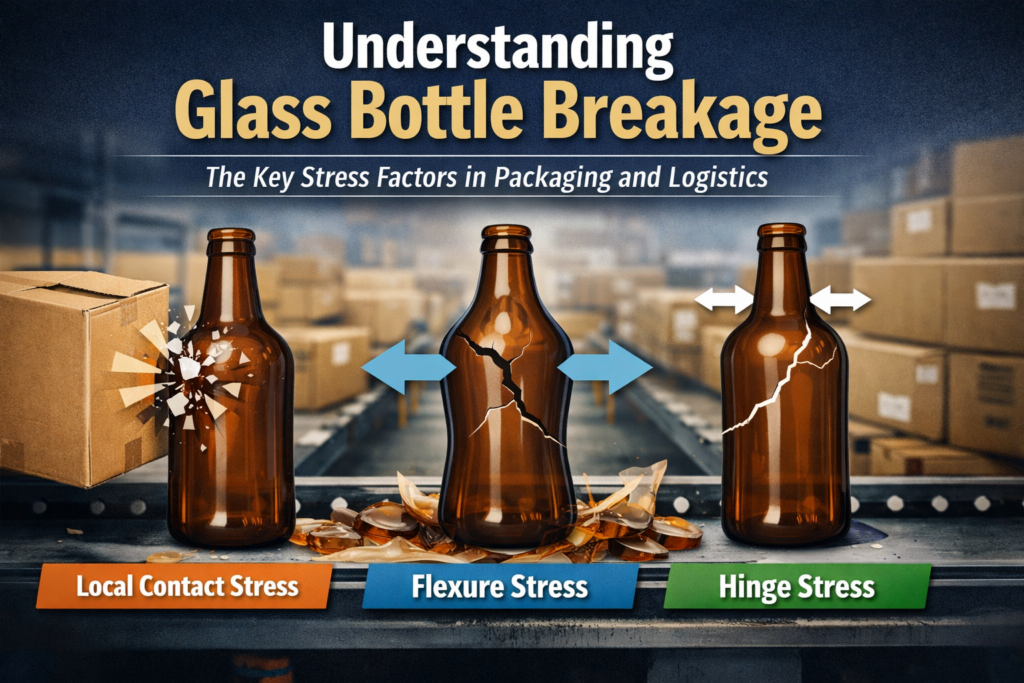
From a packaging engineering perspective, a broken glass bottle is the result of tensile stress exceeding the material’s strength limit. In the logistics environment, these stresses manifest in three primary forms: Local Contact Stress (impact at the surface), Flexure Stress (inward deformation of the wall), and Hinge Stress (outer surface tension).
To mitigate these forces, two critical engineering trends have emerged:
Strategic Lightweighting: By optimizing bottle geometry—such as increasing heel contact height and smoothing shoulder transitions—manufacturers have achieved an average mass reduction of 12% since 2021. This improves flexibility, allowing the bottle to dissipate impact energy more effectively than rigid, thick-walled designs.
Surface Fortification: The application of hot-end (tin oxide) and cold-end (polyethylene wax) coatings can improve impact resistance by 30-50%. These coatings provide lubricity, allowing bottles to slide against each other on high-speed filling lines and during transit vibration rather than shattering.
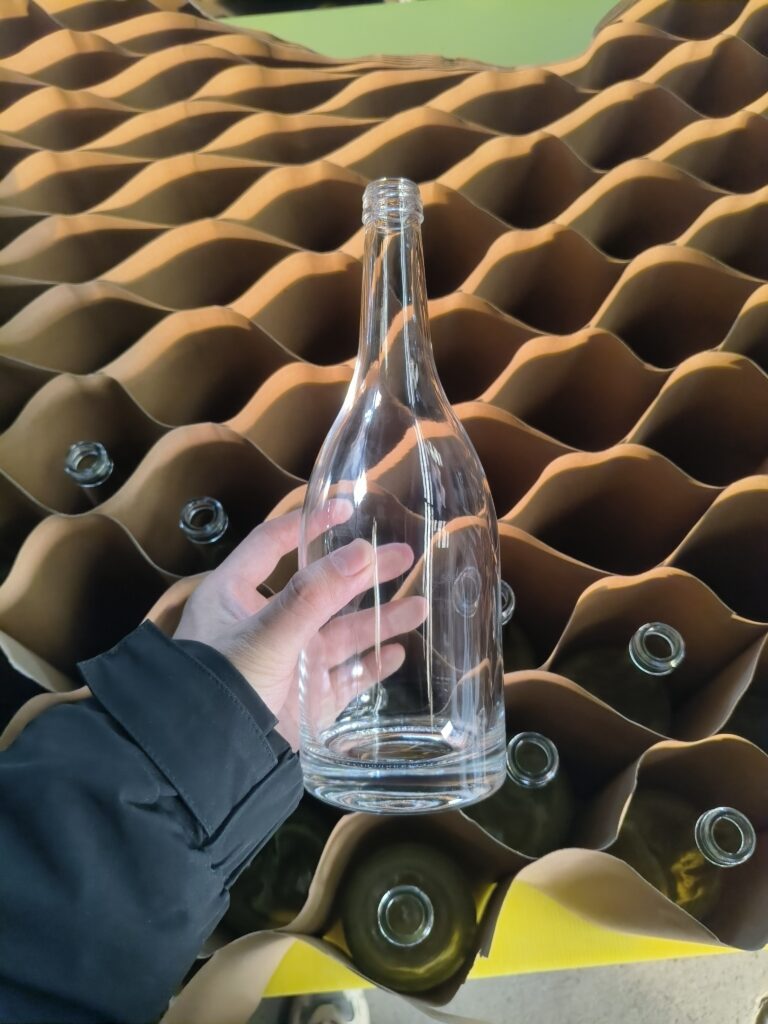
Secondary Packaging Evolution: The shift from traditional corrugated dividers to honeycomb paperboard partitions has proven transformative. Honeycomb’s hexagonal structure acts as a shock absorber, distributing energy across a wide surface area and reducing sea freight breakage from 3% to less than 0.5%.
Strategic Recommendations for Shandong Valiant Packaging
As a leading global manufacturer, Shandong Valiant Packaging must leverage its expertise to provide “bottling-to-shelf” integrity for international traders. We propose three pillars for our 2026 strategy:
- Digital Twin Integration: Valiant should implement “digital container twins” (IoT sensors like ShockQC) during the custom mold design phase to identify structural weak points before mass production.
- Sustainability-Driven Durability: Aligning with our ISO 14001 certification, we recommend bundling premium glass orders with custom-engineered honeycomb secondary packaging. This reduces the carbon footprint of replacement shipments while ensuring product safety.
- Lightweight Luxury (Rightweight®): We must continue our investment in Narrow-Neck Press-and-Blow (NNPB) technology to meet the “Lightweight Luxury” trend, reducing freight costs for our partners without sacrificing the premium tactile feel.
Conclusion and Outlook
The future of glass packaging lies in its transformation from a passive container to an engineered, data-monitored asset. While a 3% breakage rate was once accepted as a cost of business, advanced coatings and IoT-monitored logistics prove that rates below 0.5% are achievable. For Shandong Valiant Packaging, bridging this “fragility gap” through technical innovation is the key to maintaining leadership in the premium spirits and wine sectors through 2026 and beyond.