
Table of Contents
Meta Description
Discover the latest Glass Bottle Manufacturing Trends shaping the packaging industry in 2026. Learn how lightweight technology, AI quality control, sustainable production, and premium customization are helping beverage brands reduce costs and strengthen their market position.
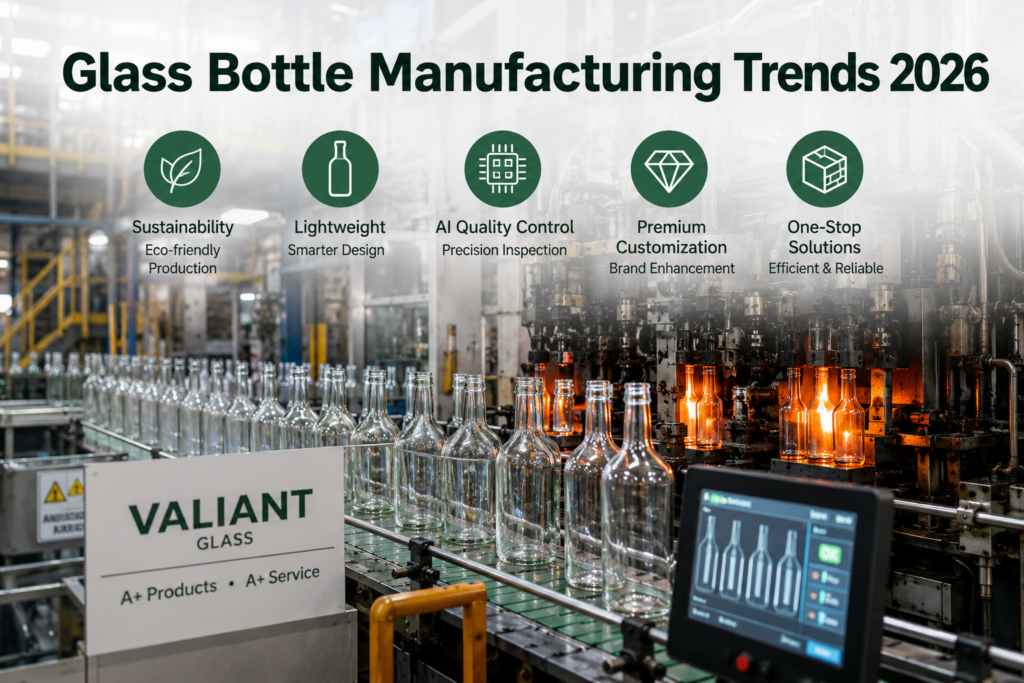
The global packaging industry is entering a new phase of innovation, making Glass Bottle Manufacturing Trends one of the most important topics for beverage brands, distilleries, and packaging buyers in 2026. Manufacturers are no longer focused solely on producing durable bottles. Instead, they are combining sustainability, intelligent manufacturing, lightweight engineering, and premium decoration to create packaging that improves brand value while lowering operational costs. Companies that understand these evolving Glass Bottle Manufacturing Trends can make better sourcing decisions, improve supply chain efficiency, and respond more effectively to changing consumer expectations. According to recent industry research, sustainability and premium packaging continue to be the strongest drivers of glass packaging growth in 2026.
Sustainability Continues to Define Manufacturing Decisions
One of the most influential Glass Bottle Manufacturing Trends is the industry’s commitment to reducing environmental impact. More manufacturers are increasing the percentage of recycled cullet used in production, lowering furnace energy consumption while reducing carbon emissions. At the same time, energy-efficient furnaces, renewable energy integration, and optimized melting technologies are becoming common investments across modern production facilities.
Government regulations in many regions are encouraging manufacturers to improve recycling rates and adopt cleaner production methods. For international beverage brands, selecting suppliers with sustainable manufacturing capabilities has become an important competitive advantage rather than simply an environmental initiative. Industry organizations also expect circular economy practices to become even more significant throughout the coming years.
Lightweight Bottles Deliver Better Logistics Performance
Reducing bottle weight without sacrificing strength has become another defining feature of current Glass Bottle Manufacturing Trends. Advanced Narrow Neck Press and Blow (NNPB) technology allows manufacturers to produce lighter bottles with consistent wall thickness while maintaining excellent pressure resistance and durability.
For exporters, lightweight bottles provide measurable benefits throughout the supply chain. Lower bottle weight reduces transportation costs, improves container loading efficiency, decreases fuel consumption, and lowers overall carbon emissions. These advantages are especially valuable for spirits brands shipping products internationally.
| Manufacturing Trend | Business Benefit | Primary Application |
| Lightweight NNPB Technology | Lower shipping costs and reduced carbon emissions | Spirits, wine, beverage bottles |
| High Recycled Glass Content | Improved sustainability performance | Premium and standard packaging |
| AI Inspection Systems | Higher quality consistency | Large-scale production |
| Premium Decoration | Stronger shelf appeal and brand recognition | Luxury spirits packaging |
| Digital Manufacturing | Faster customization and shorter lead times | OEM & ODM projects |
Industry reports indicate that lightweighting has become a standard objective for many premium bottle manufacturers because it balances environmental responsibility with commercial efficiency.
Artificial Intelligence Improves Production Quality
Digital transformation is reshaping Glass Bottle Manufacturing Trends through artificial intelligence and machine learning. Modern inspection systems equipped with AI vision technology can detect tiny defects, dimensional variations, and surface imperfections much faster than traditional manual inspection.
In addition to quality inspection, predictive analytics help manufacturers optimize furnace temperatures, forming parameters, and production scheduling. These technologies reduce waste, improve consistency, and increase production efficiency across high-volume manufacturing lines. Academic research also demonstrates the growing role of deep learning in optimizing glass bottle forming processes and maintaining stable production quality.
Premium Customization Becomes a Brand Strategy
Premium beverage brands increasingly view packaging as an essential marketing asset. As a result, another important direction within Glass Bottle Manufacturing Trends is advanced customization. Embossed logos, deep engraving, frosting, metallic coatings, silk-screen printing, and distinctive bottle silhouettes all contribute to stronger shelf presence and greater consumer recognition.
Rather than relying solely on labels, many brands are integrating visual identity directly into the bottle itself. This approach improves durability, enhances premium perception, and creates a memorable customer experience. Manufacturers capable of offering complete decoration services alongside bottle production are becoming preferred long-term partners for international spirits companies.
One-Stop Packaging Solutions Gain Momentum
Global buyers increasingly prefer suppliers capable of delivering complete packaging solutions instead of sourcing components from multiple vendors. This is one of the fastest-growing Glass Bottle Manufacturing Trends because it simplifies procurement, shortens lead times, and improves quality consistency.
A comprehensive packaging supplier can provide custom glass bottles, bottle closures, corks, cartons, decoration, mold development, and technical support within a single project. This integrated approach minimizes communication risks while allowing brands to launch new products more efficiently.
If you are looking for an experienced manufacturing partner, VALIANT Packaging offers customized glass bottles, closures, packaging accessories, decoration services, and OEM/ODM production for global beverage brands. Visit our company website to learn more about its complete one-stop packaging solutions.
For additional information about sustainable glass packaging and recycling initiatives, readers can also refer to the European Container Glass Federation (FEVE) , which provides valuable industry insights into glass sustainability.
Conclusion
The most significant Glass Bottle Manufacturing Trends in 2026 demonstrate that successful manufacturers are balancing sustainability, intelligent automation, lightweight engineering, premium aesthetics, and integrated supply chain services. Buyers who align with these developments will benefit from improved product quality, lower logistics costs, greater environmental performance, and stronger brand differentiation. As consumer expectations continue to evolve, selecting a manufacturing partner that embraces these Glass Bottle Manufacturing Trends will be essential for maintaining competitiveness in the global beverage packaging market.